

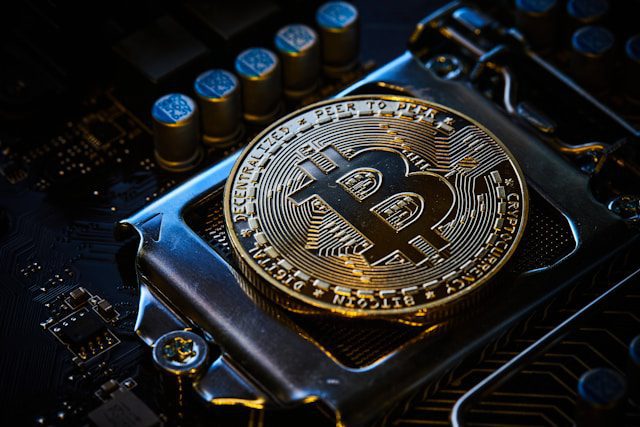

Bitcoin famously works via a technology called blockchain. This is a form of distributed ledger, which ensures that every transaction is recorded in a way that’s immutable and effectively impossible to tamper with. This allows the network to remain secure without oversight from a central authority.
One key aspect of this process is that of ‘mining’. But what is mining, and how does it work?
What Bitcoin mining actually does
New transactions are recorded in bundles, known as blocks. For the ledger to be updated, new blocks need to be continuously added. But how can we be sure that the person adding the new block is trustworthy? In the case of Bitcoin, the answer lies in ‘proof of work’.
In order to add a new block, individuals must compete to solve a very difficult puzzle. This is where cryptography comes in. By forcing contributors to do difficult work, and allowing other members of the network to check that work, we can limit the rate at which new blocks can be added. This is ‘mining’ – the process of guessing a number (known as a nonce, or ‘number used once’).
When a new block is added to the chain, it produces a special number called a hash. This is a result of the contents of all the previous blocks, and thus it allows us to instantly see when a block has been tampered with. Thus, when one person’s version of the chain doesn’t ‘hash out’ to the same number as everyone else’s, that version can be disregarded. This way, through consensus, we can keep the ledger secure.
The hardware and electricity behind it
In order to do the work required, bitcoin miners make use of highly specialized computers. These machines are built to do this kind of work, and nothing else. This machine is known as an Application Specific Integrated Circuit (ASIC). When mining, all of the resources of this machine are entirely focused on the task. Miners will often link extremely large numbers of these machines together, because the rewards for doing so are potentially so considerable.
Of course, all of this is a major drain on electricity. For this reason, many miners relocate to regions where electricity is cheap and abundant. When this major operating cost is controlled, the operation becomes much more profitable.
Why mining matters in 2026
In order to keep block production stable, the difficulty of the work needs to be continually adjusted upwards. This means that a would-be attacker would face exorbitant costs, were they to try to modify the entire network at once.
The difficulty is adjusted every two weeks, in order to keep block production stable. Miners are paid using a subsidy, which is currently 6.25 BTC. But in around 2028, this will be cut in half, to 3.125. This has major implications for profit margins, which is why so many US-based miners are seeking to diversify into AI, and other work for which ASICs are suited.
What everyday users should understand
So, what if you’re not concerned with maintaining the blockchain, and simply want to deal in Bitcoin? The good news is that there are many services that seek to keep the internal workings of the system hidden. You can buy Bitcoin on the street using a Bitcoin ATM.
However, if you’re looking to invest in the long term, and you want to understand the impact of would-be regulation on the value of the asset, it’s worth learning how things work, at least in a very basic sense.