

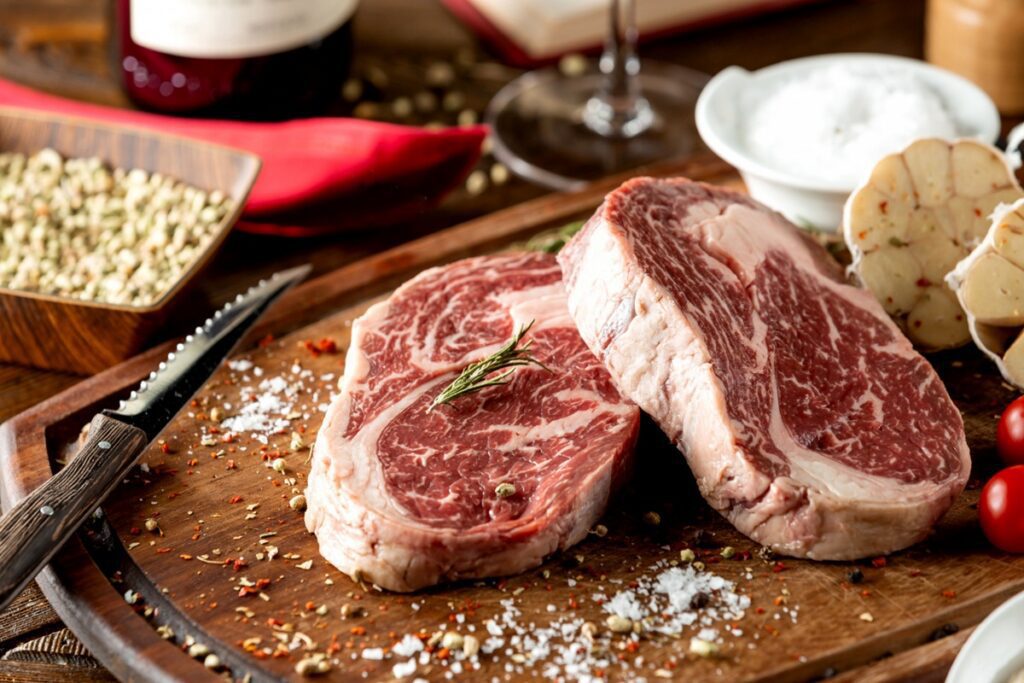

North Jersey’s restaurant scene has been doing something interesting lately. Walk through Hoboken, Jersey City, or the smaller towns dotted across Bergen, Hudson, and Union counties, and you’ll notice that the number of places serving serious steak has quietly climbed. Not steakhouses in the old-school Peter Luger sense, exactly—those still anchor the conversation. Something more layered: chef-driven Italian spots with dry-aging programs, neighborhood gastropubs whose meat sourcing rivals the white-tablecloth places, restaurants treating beef the way a sushi bar treats fish.
For people who actually eat out in this part of the state, it’s been a slow-motion shift you could probably feel before you could name it. Reservations get harder. Menu prices climb. The cuts being served get more specific. And what tends to happen next, after the dining-out wave crests, is the same thing that happened with sourdough during the pandemic and with cocktails in the years after Mad Men: home cooks start trying to keep up.
What’s Actually Happening on the Menus
Take Battello in Jersey City, the kind of waterfront restaurant that’s been on every roundup of the state’s best dining for years now. Chef and co-owner Ryan DePersio’s pasta program gets the headlines—the hand-made ricotta gnocchi with sweet sausage bolognese deserves them—but spend a few minutes with the menu and the meat section is doing real work too. Fennel-crusted pork chops, dry-aged imported branzino, careful cuts of beef treated like the centerpiece they’re meant to be, not a default option.
Then there’s Black Sheep up in Union County, where Vincent Comunale and Chef Nick DeRosa are running a place that walks the line between gastropub and a proper chop house. DeRosa comes from a line of butchers, and the menu reads that way—confident about meat in a way you don’t see often at the neighborhood-restaurant price point.
These aren’t outliers. They’re the visible edge of a wider shift. Across North Jersey you can find Italian-American restaurants quietly adding 45-day dry-aged ribeyes to their specials boards. Hudson County tasting menus now build their second course around a small portion of A5 instead of foie gras. Smaller suburban spots that used to top out at a New York strip are listing tomahawks for the table. None of this would have been a normal Tuesday-night menu ten years ago. It is now.
Why It’s Happening Here, Right Now
A few things are converging at once. North Jersey is one of the highest-income media markets in the country, which means there’s a willing audience for the price tags these cuts command. The post-2020 restaurant economy pushed chefs to differentiate themselves, and doing serious beef is one way to do that without competing directly with everything happening across the river in Manhattan. And sourcing has genuinely gotten better—small Japanese importers, US-based dry-aging programs, and Australian producers have made cuts available that simply weren’t, fifteen years ago, accessible to a mid-sized regional restaurant.
The other piece is cultural. People who grew up eating Sunday dinner in this part of the state are, generationally, the most likely customers for any restaurant trying to sell a $90 steak. The food is familiar. The willingness to spend on it is familiar. What’s new is the breadth of what’s actually on offer, and the chefs willing to put their names on it.
The Wagyu Question
This is where things get interesting for anyone trying to make sense of what’s actually being served.
The word “Wagyu” on the menu has gotten loose in the last decade. The term technically refers to four specific Japanese cattle breeds, but in practice you’ll see it applied to American hybrids, Australian crossbreds, and full-blood Japanese imports—all under the same four letters. The differences in flavor, texture, and price are not small.
The full-blood Japanese version, graded A5 by Japan’s official grading system, is the one that gets photographed and posted to Instagram. It’s hyper-marbled, almost ivory shot with pink rather than red streaked with fat—the official Beef Marbling Standard (BMS) score has to hit 8 or above for A5 certification, and the very highest cuts touch 12. A few ounces is a portion. The flavor is closer to a rich pâté than to what most people picture when they hear the word steak. When North Jersey restaurants serve real, certified Japanese A5 Wagyu—typically striploin, chuck eye, or ribeye—this is what they’re working with, and the menu price reflects the reality of getting it here. The handful of US retailers, Destination Wagyu among them, that import to this standard work with the same Japanese export channels the restaurant trade uses.
Australian Wagyu—usually a cross between Japanese breeds and Angus—sits in a different lane. More marbling than commodity beef, less than Japanese A5, scaled to portions an American diner actually expects to see on a plate. Most of the dry-aging programs at the neighborhood-restaurant tier of this trend are working with Australian-style crossbred Wagyu, even when the menu doesn’t say so explicitly. It’s the format that works best at a real steakhouse portion size.
The takeaway for a curious diner: the word on the menu doesn’t tell you what you’re eating. The grading, the country of origin, and the cut do.
What This Means for Home Cooks
Here’s the part that doesn’t get talked about as much. Every wave of restaurant interest in a specific ingredient eventually trickles into home kitchens, and beef is in the middle of that cycle right now.
A serious cut of beef cooked at home has a structural advantage over the restaurant version: you control the portion, you control the heat, and the per-ounce cost—even with cuts that feel intimidating on a menu — is dramatically lower than the markup baked into a restaurant tab. A small portion of Japanese A5, treated as the focus of a tasting course rather than a sixteen-ounce slab of dinner, can sit comfortably inside the budget of a Saturday night that would otherwise have been a reservation.
The trickier piece is sourcing. The local supermarket is not where this story ends. The same kind of vendors that supply North Jersey’s better restaurants are increasingly accessible to home cooks directly. A handful of reputable online retailers—Destination Wagyu among them—now ship directly to home kitchens nationwide, with the kind of cut selection and consistency that used to require a wholesale account. That’s how most home cooks who get into this end up going deeper— they try a small order, they realize what’s actually available, and they start treating their freezer as a curated thing rather than a backup.
For everyday cooking, Australian Wagyu cuts—striploin, ribeye, the occasional flat iron — sit at a more approachable price point and behave more like the beef most home cooks already know how to handle. They reward attention without requiring the surgical precision a single ounce of A5 demands.
Practical Notes on Cooking It
A few honest things worth saying, since the internet is full of bad advice on this subject.
Heavily marbled beef does not want a long sear. The fat starts rendering almost immediately. With a real Japanese A5 portion, you’re closer to searing a piece of sashimi than to grilling a strip steak—a hot pan, brief contact on each side, coarse salt at the end, and that’s it. Anything longer and you’ve melted the thing
you paid for.
Australian Wagyu wants more conventional treatment but still less than commodity beef. A reverse sear works beautifully. A cast-iron pan with butter, garlic, and thyme is fine, if a little old-fashioned. Resting matters more than people think; rushing it is the single most common home-cooking mistake on this kind of cut.
Salt is the only seasoning that earns its place in either format. Coarse, applied late, on a hot surface. Any rub or marinade more aggressive than that is fighting the meat instead of supporting it.
What the Restaurant Trend Leaves Behind
The North Jersey steakhouse wave will keep cresting for a while. New places will open. The good ones will get harder to book. Eventually, like every restaurant trend, it will plateau and a new one will take its place.
What’s likely to stick is the shift in what regional diners now expect from beef—and what a small but growing group of home cooks are now willing to keep in their own freezers. Once you’ve had a properly sourced, properly cut piece of Wagyu, a generic supermarket ribeye is hard to go back to. That’s not snobbery; it’s the same logic that made people start caring about coffee beans, olive oil, or Parmigiano-Reggiano. The information became available, the sourcing got easier, and the difference was real enough to be worth chasing.
For the home cook who’s been watching the menus around Hoboken and Jersey City and wondering what it would take to bring some of that home, the answer is: less than you’d think, and probably not nearly as expensive as the equivalent reservation would have been.

Lifelong Jersey resident and Rutgers and FDU alumnus, Tom La Vecchia is publisher of New Jersey Digest, one of the state’s leading lifestyle media brands. When he’s not growing the Digest, he’s raising four kids, wrangling four cats and pretending it’s all under control. His mission: keep Jersey interesting and impossible to ignore.
