

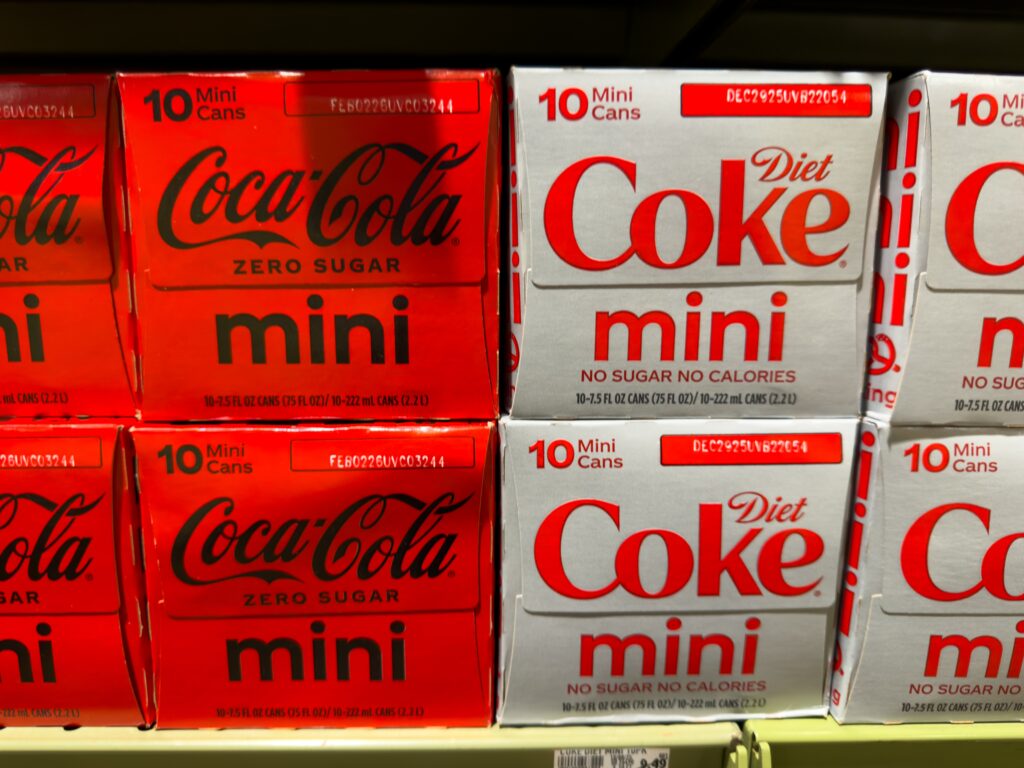

If you rely on a daily Diet Coke to get you through the work day, you might want to reconsider.
A new study published in Neurology Journals says heavy artificial sweetener use might speed up memory loss. It’s been everywhere the last few weeks, first published all the way back in November, then quietly corrected, twice.
Turns out the actual science is a lot messier than the coverage suggests.
What the Study Actually Found
Researchers followed 12,772 Brazilian public servants for eight years as part of a larger health study, tracking seven common sweeteners: aspartame, saccharin, acesulfame-K, erythritol, xylitol, sorbitol, and tagatose. Average age at the start was just under 52.
People filled out food questionnaires and took cognitive tests three separate times over the study. Researchers then split participants into three groups based on how much sweetener they reported consuming.
The headline number: people in the top third for sweetener intake saw cognitive decline speed up by 62 percent compared to the bottom third, roughly 1.6 years of extra brain aging.
The middle group wasn’t far behind, 35 percent faster, about 1.3 years. Six of seven sweeteners tracked individually with the decline. Only tagatose came back clean. And the effect only showed up in people under 60—nothing in older adults.
Why Some Scientists Aren’t Buying It
Here’s where it gets complicated. Epidemiologist Gideon Meyerowitz-Katz broke the study down for ScienceAlert, and his read is blunt: this research “doesn’t really show any issues from artificial sweeteners at all.”
Start with the data itself. Sweetener intake wasn’t measured, it was self-reported through food frequency questionnaires, which ask people to recall their eating habits over the past year. People are notoriously bad at this. Think about it: could you accurately monitor your food and drink intake over a prolonged period? The study also only collected the information only once, so if anyone’s diet changed at all during those eight years, there’d be no way to know.
Then there’s the biology of it. Six of these substances are chemically unrelated, some natural, some synthetic, one an actual rare sugar. The idea that all six independently damage the brain in the same way doesn’t have an obvious mechanism behind it, according to Meyerowitz-Katz.
There’s also the question of which came first. People already dealing with early cognitive decline from conditions like diabetes or heart disease may simply be more likely to reach for artificial sweeteners in the first place, not the other way around.
And then there’s the part that didn’t make headlines. Buried in the study’s supplementary appendix is a separate analysis, using the full participant pool instead of a filtered subset, that found no relationship between sweeteners and cognitive decline at all. The widely reported 62 percent figure came from an analysis that excluded certain participants, including anyone with Parkinson’s disease or unusually high calorie intake. Add in confirmed mathematical errors that required two published corrections, one of them affecting the confidence interval reported in the study’s own abstract, and the foundation underneath this headline starts to look shaky.
None of this means artificial sweeteners are risk-free. But the current evidence, according to Meyerowitz-Katz, still points the other way: sweeteners remain well-studied and are generally considered safer than sugar—not the reverse.
So, maybe that afternoon Diet Coke isn’t so bad after all. Life is short. Enjoy your lunchtime fizzy drink.

The New Jersey Digest is a new jersey magazine that has chronicled daily life in the Garden State for over 10 years.