

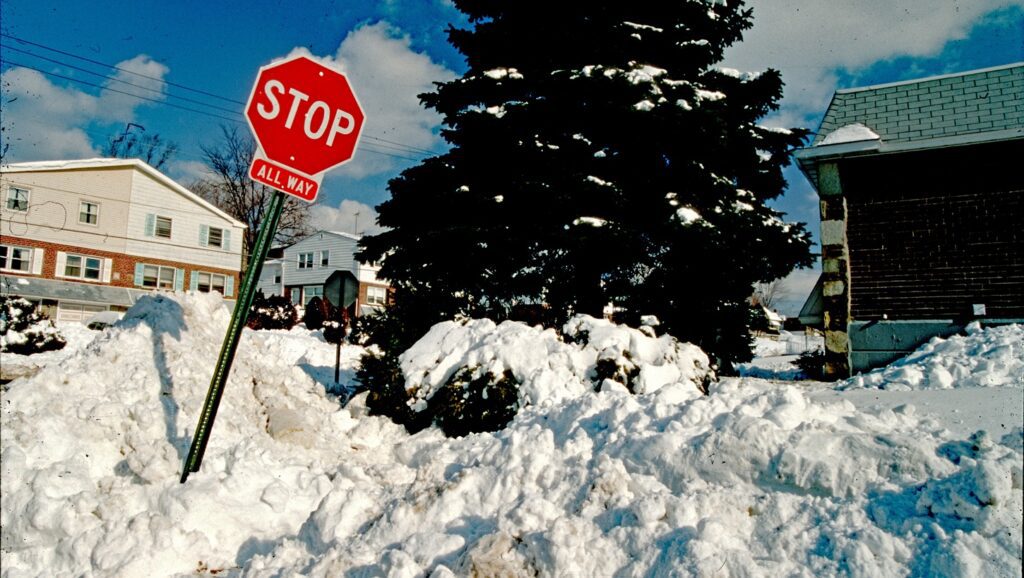

For New Jerseyans of a certain age, winter memories tend to blur together—until someone brings up January 1996. Then it all comes rushing back.
The drifts. The silence. The sense that the state had been completely shut down.
Thirty years ago this winter, snow began falling across New Jersey and didn’t seem to stop. What started in the early morning hours of January 7, 1996, quickly escalated into one of the most disruptive and deadly winter storms the state had ever experienced. By the time it ended late the following day, the Blizzard of ’96 had carved itself into New Jersey history.
Snow pushed northward across the state throughout January 7, reaching North Jersey by mid-morning. According to a later National Weather Service analysis, intense snow bands set up on January 8, dumping snow at rates of an inch per hour or more across wide portions of the state. For many communities, the snow didn’t taper off until well into the evening.
As conditions worsened, then-Governor Christine Todd Whitman declared a state of emergency. All non-essential travel was banned. The New Jersey Turnpike closed entirely for the first time in its history. Drivers became stranded at rest stops along the Parkway and Turnpike, unable to move in either direction.
By the end of the storm, snowfall totals reached staggering levels. Parts of the state recorded up to 32 inches. Edison led the way, while towns like Boonton saw like 28 inches and even communities farther south, including Raritan, still logged around 30 inches. Newark Airport shattered its single-storm snowfall record with 27.8 inches, surpassing a mark that had stood since 1947.
The impact went far beyond numbers. Schools and businesses shut down statewide. Mail service was disrupted. Sporting events were canceled. Thousands of homes lost power as high winds and heavy snow brought down trees and lines. Roof collapses were reported in multiple locations.
The storm also proved deadly. At least 28 people in New Jersey lost their lives, many from heart attacks while shoveling snow. For some residents, digging out wasn’t a one-day task—it took days.
And yet, for many who grew up during that storm, memories of the Blizzard of ’96 aren’t just about hardship. Kids tunneled through drifts. Families built snow forts and spent days together indoors. For a brief moment, the state came to a complete halt.
At the time, the storm was regarded as the largest snowfall event ever experienced by such a densely populated area in the United States. It also capped off the snowiest season New Jersey has ever recorded. During the 1995–96 winter, 122 inches of snow fell at High Point Park, a total that was officially certified decades later by a State Climate Extremes Committee as the state’s all-time seasonal snowfall record.
In many parts of New Jersey, that single January storm accounted for as much as a third of the entire season’s snowfall.
“I was at work until 11 pm. Expected more snow, but nothing like what we got,” said Reddit user Lanky-Description691 of the 1996 Blizzard. “No warning for anything like that. I couldn’t figure out why friends were calling me early in the morning to see if I had gotten home. Finally, I [opened] the drapes and could not believe the amount of snow.”
Will a Blizzard like 1996 Ever Happen Again?
So the question that keeps coming up—especially during quieter winters—is simple: will it ever happen again?
Meteorologists say it’s possible, but far less likely than it once was. Climate data shows New Jersey has warmed roughly three degrees since the mid-20th century. That small number makes a massive difference when it comes to snow. Cold air doesn’t linger as long. Storms are more likely to mix with rain. The margin for error is thinner.
The Blizzard of ’96 wasn’t a fluke, but it belonged to a colder era. Today, for a storm of that magnitude to unfold, everything has to align perfectly. Deep cold must be locked in for days. High pressure must hold firm to the north. A coastal storm must track just far enough offshore. Any deviation, and rain takes over.
New Jersey’s outlook for the 2025–26 winter reflects that uncertainty. Some forecasts point to a generally milder season with below-average snowfall. Others suggest sharp temperature swings and the potential for isolated high-impact storms, similar to what the state has already experienced at times this winter. All this despite having one of the heaviest snows in recent Tri-State memory.
What’s clear is that storms like 1996 are no longer routine. When they happen, they feel shocking—less like weather, more like history repeating itself for a brief moment.
For those who lived through it, the Blizzard of ’96 remains the measuring stick. And three decades later, it still looms over every winter forecast in New Jersey.

The New Jersey Digest is a new jersey magazine that has chronicled daily life in the Garden State for over 10 years.