

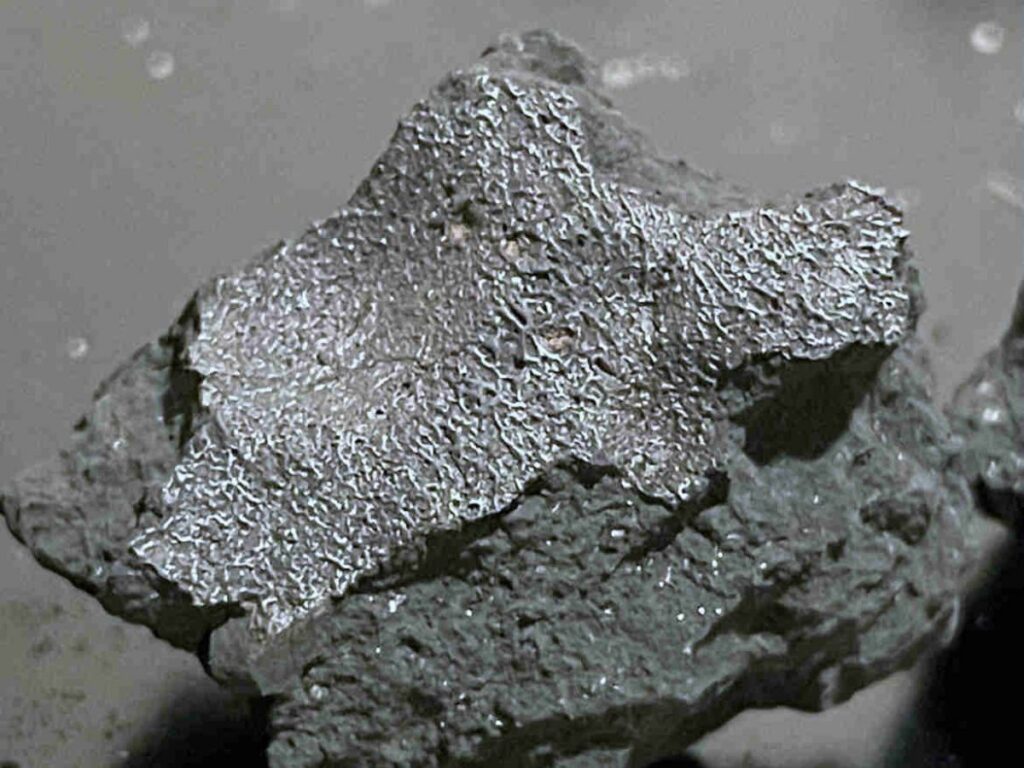
A meteorite crashed through a New Jersey couple’s bedroom ceiling in 2024. Two years later, scientists say it may hold the literal building blocks of life. What?
On the morning of July 16, 2024, a foot-long asteroid streaked across the sky above New York City, producing a fireball and a sonic boom heard as far as Connecticut and Pennsylvania. NASA figured it was too small to matter—the kind of object that burns up completely before it ever touches ground, according to The New York Times.
It didn’t burn up. Three minutes after the fireball passed overhead, a Hillsborough man working in his home office heard a crash so loud he assumed his kitchen cabinets had come off the wall. He went to check. Instead, he found a hole punched clean through his bedroom ceiling—soot on every surface, a sulfurous smell hanging in the air, and a handful of onyx-colored rocks sitting on his pillow.
Before it hit the atmosphere, the asteroid weighed roughly 115 pounds and was moving at 32,000 miles per hour. Nearly all of it disintegrated on the way down. What survived — a three-pound fragment—was enough to put a hole through someone’s roof.
If the rock was hoping to stay anonymous, it picked the wrong house. For weeks afterward, the homeowners collected every trace of debris they could find—peeling flecks of dust off the walls with tape, buying a vacuum just for pulling cosmic particles out of the carpet. They labeled and sealed every fragment to keep it from contamination, then said nothing publicly for two years while scientists worked.
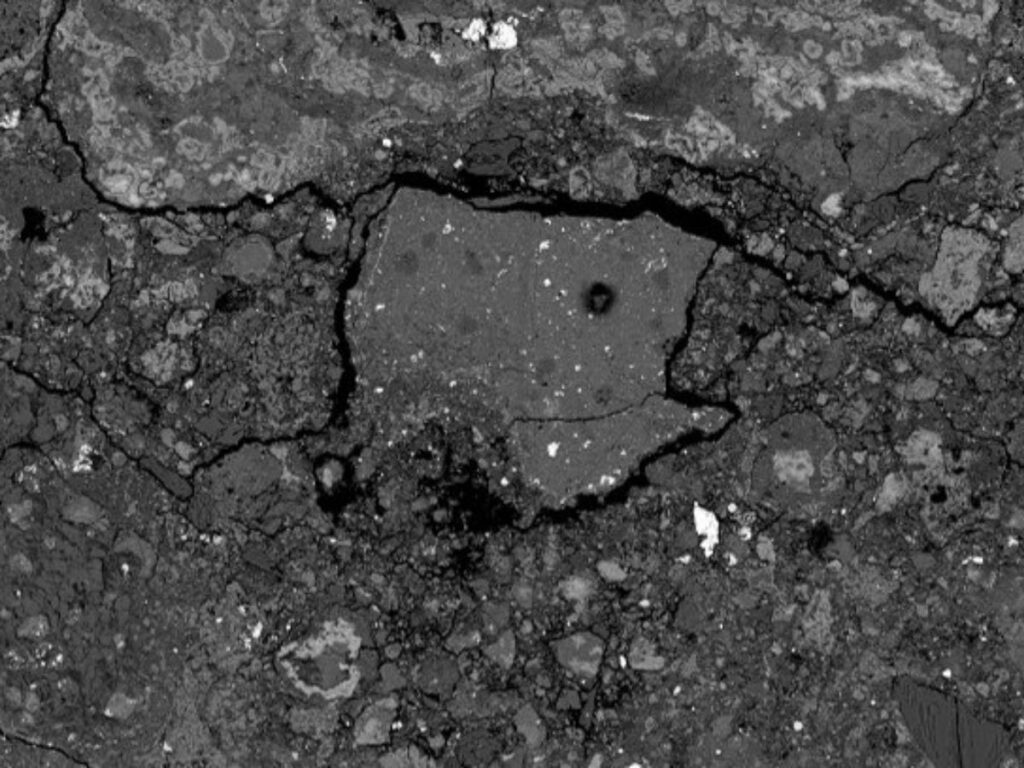
That patience turned out to matter. The object is a CM1/2 carbonaceous chondrite—a rare type of meteorite, and only the second fall of its kind ever observed. Researchers are calling it one of the most scientifically valuable meteorites ever recovered, according to a news release from the SETI Institute. The findings were published Wednesday in the journal Science Advances.
Inside it: complex organic molecules, amino acids, and magnesium organic compounds—the same compounds found in human blood and used in photosynthesis. Stranger still, researchers found evidence that the meteorite’s parent asteroid once held salty liquid water, long since evaporated into concentrated brine. That kind of brine can drive the exact molecular reactions scientists think were necessary for life to begin in the first place, according to CBS News.
Put plainly: this rock may be chemically similar to whatever first seeded Earth with the raw materials for life, billions of years ago.
The object’s backstory reaches deep into the solar system. Scientists trace its origin to 163 Erigone, a massive asteroid that formed in the cold outer reaches beyond Jupiter. About 155 million years ago, a collision shattered it into a new family of fragments—the same lineage that includes Donaldjohanson, the peanut-shaped asteroid NASA’s Lucy spacecraft photographed in 2025. Around 6 million years ago, another impact knocked loose a smaller piece that drifted toward Earth’s neighborhood. Then, roughly 200,000 years ago, a 115-pound chunk broke away for good—beginning a journey that ended in a New Jersey bedroom.
The odds of recovering anything this clean were slim. This kind of meteorite is fragile—scientists describe it as similar to a packed mud ball—and it breaks down fast once exposed to rain. Weather radar shows fragments likely scattered across a stretch between Staten Island and Hillsborough, but nothing turned up outside the couple’s home. Most of it probably melted into the ground before anyone thought to look.
A portion of the meteorite is now headed to the American Museum of Natural History in New York City, just 30 miles from where it landed.
As for the homeowners—who’ve asked to stay anonymous—the timing is its own kind of strange. They closed on the Hillsborough house in January 2024. Six months later, they got a new resident. It came from outer space.

The New Jersey Digest is a new jersey magazine that has chronicled daily life in the Garden State for over 10 years.
