

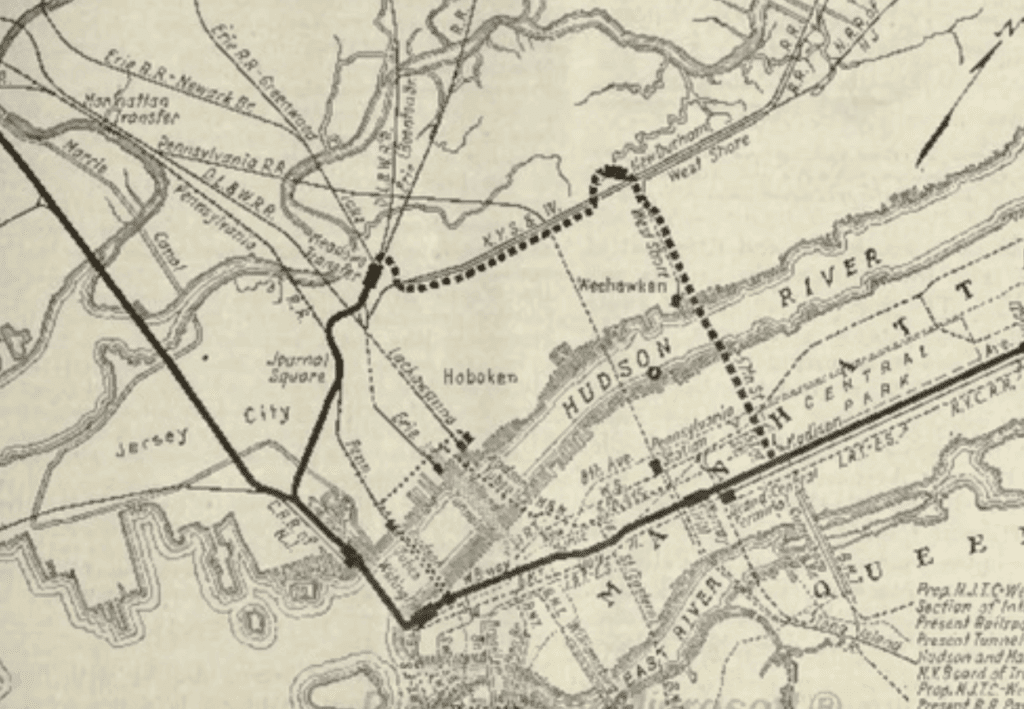

During the Roaring Twenties, New York City was in the midst of a transit revolution, but one of the boldest ideas of the era never left the blueprint stage. If it did, we could live in a completely different version of New Jersey today.
In 1926, the North Jersey Transit Commission released a revolutionary proposal: a massive subway network extending from Manhattan into New Jersey, linking cities like Newark, Hoboken and Union City directly to New York.
The centerpiece was an interstate loop line that stretched 17 miles from New Jersey under the Hudson River to Manhattan via two tunnels—one uptown, one downtown.
Picture this: 35 eleven-car trains running by each hour, carrying nearly 200,000 passengers daily. The loop would have functioned as a transit hub rivaling any in New York, seamlessly connecting the region’s railroads while alleviating the growing commuter traffic that was already straining ferries and terminals. The plan would have essentially connected North Jersey to the city in a way it never has been before.
Extensions of the IRT Flushing Line and BMT Canarsie Line were also on the table. Hoboken could have seen subway service just steps from the city center—Union City streets might have stacked with commuters riding the Flushing Line to Manhattan. Some proposals even included extensions into Westchester County, New York.
However, the high price tag kept the plan permanently in the drafts. The project was expected to cost $154 million for construction, plus $40 million for equipment. It was an expense far too high for a region about to be decimated by the Great Depression.
Major part of my transit wishlist: I'd love to see NYC embrace a regional map of 🚇 and 🚊 services. NYC is part of a regional economy and community– it would be a major win if commuters could visualize PATH, HBLR and Newark City subway alongside the NYC subway system.
[image or embed] — Shabazz Stuart (@shabazzstuart.bsky.social) November 24, 2025 at 1:19 PM
The dream for an NYC-NJ subway connection would resurface multiple times over the decades. The Regional Plan Association made a push in the 1950s to extend the Canarsie Line under the Hudson and into New Jersey. In the 1960s and 1980s, proposals to extend the Flushing Line into New Jersey to connect commuters to Manhattan. Most recently in 2010, NYC Mayor Michael Bloomberg suggested a 7 Line extension that would run all the way to Secaucus Junction—a plan that transit enthusiasts still discuss today, showing that the dream for an NYC-NJ subway connection is alive and well.
The 1926 plan was about more than simply transportation—it proposed a blueprint for an NYC metro fully integrated across state lines.
The New York City subway sees an annual ridership of well over 1 billion, but just imagine how that number could shift with millions more from New Jersey using it each day instead of commuting via bus, car or traditional NJ Transit. Forget transfers and parking, what if your commute was as seamless as riding the subway? That’s what could have been.
For a closer look at the maps and diagrams outlining this shelved proposal, see the February 1926 and 1927 issues of Electric Railway Journal, detailing the proposed loop line and the “Meadows Transfer Station” near present-day Croxton Yard in Jersey City.

The New Jersey Digest is a new jersey magazine that has chronicled daily life in the Garden State for over 10 years.