


New Jersey’s coastline faces another season of erosion just as federal support for beach nourishment stalls in Congress. After lawmakers removed beach replenishment funding from the 2025 budget, Shore towns now must confront shrinking dunes, rising costs and a timeline that no longer aligns with the Atlantic’s storm cycle.
New Jersey’s beaches lose sand faster than nearly anywhere else on the East Coast. Heavy nor’easters this fall carved steep drop-offs in Ocean City, Strathmere and sections of North Wildwood, leaving dunes thinner and walkways damaged. In most years, U.S. Army Corps of Engineers projects restore the lost sand on a multi-year rotation. This year, that rotation broke.
Only a fraction of federal spending bills have passed so far, and the Energy and Water bill—which supports the Army Corps—remains frozen under a continuing resolution until Jan. 30, 2026. The House version includes only a small pot of money for beach work nationwide. The Senate has yet to release its draft. Without clarity from Congress, local leaders have begun to plan around the possibility that no major replenishment cycle will reach their towns for at least another year.
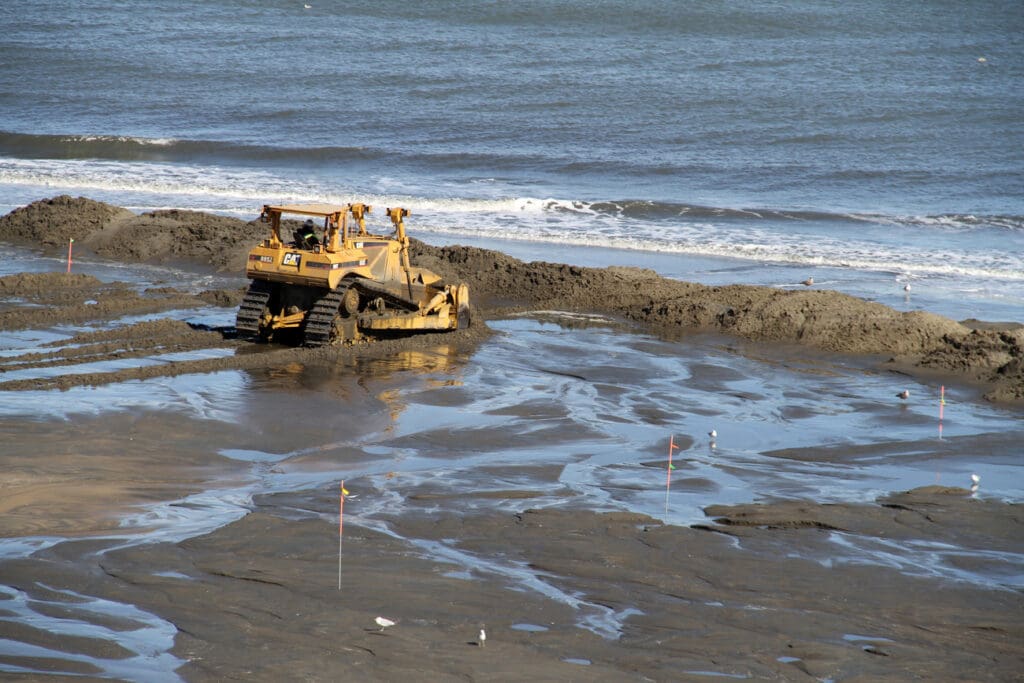
The state’s Department of Environmental Protection continues to advise towns to move quickly on maintenance and emergency dune shaping. Officials say local public-works crews hold the experience needed for short-term sand moves, but those efforts cannot replace full-scale nourishment projects that rebuild entire stretches of coastline. Some misplaced sand may settle offshore and drift back if winter conditions stay mild, but towns have learned not to rely on that outcome.
In Cape May County, several municipalities have reviewed experimental erosion-control systems used in calmer Gulf waters—offshore structures shaped like wide plastic barriers that hold sand and force breaking waves to lose energy before hitting the shoreline. Engineers caution that the Atlantic’s deeper waters and stronger wave action create a different challenge, but local leaders feel pressure to explore every possible option as federal dollars sit out of reach.
The freeze comes at a time when the Shore anchors a record tourism economy. New Jersey welcomed more than 123 million visitors in 2024, and coastal counties generated nearly a third of the state’s $50.6 billion in visitor spending. Cape May County alone produced more than $8 billion. Beach width influences rental demand, boardwalk traffic, business sales, seasonal jobs and the overall stability of barrier-island communities. Even a single washed-out access path can limit public safety response times during busy summer weekends.
New science adds urgency. A Rutgers-led report released this year projects up to 1.7 feet of sea-level rise by 2050. Atlantic City already sees minor flooding far more frequently than it did in the mid-20th century, and rising water levels increase the likelihood that storm surges will reach farther inland. If erosion continues unchecked, communities may deal with repeated overwash events, compromised dunes and higher long-term risks to infrastructure.
New Jersey’s Shore Protection Fund remains at $25 million a year. The state gives priority to projects with federal partners, which complicates this year’s funding gap. A proposal to double the fund did not advance, and a separate bill that would expand it sits stalled in the Legislature. As a result, towns may need to absorb higher local costs or rely more heavily on occupancy-tax revenue collected in beach counties. Those counties generated more than $53 million in occupancy-tax revenue last year, and some local officials argue that a portion of that money should return directly to shoreline protection.
The freeze also affects more than beaches used for recreation. Narrower coastlines reduce storm buffers, limit emergency access, and increase pressure on utilities, roadways and public infrastructure. Barrier-island communities face the added challenge of maintaining evacuation routes and managing long stretches of dune systems that protect homes and businesses behind them.
New Jersey’s coastline has weathered generations of storms, but the combination of stronger nor’easters, rising seas and a sudden loss of federal assistance leaves the region exposed. Without a reliable funding path, Shore towns must plan for another year where erosion moves faster than the budget meant to stop it.

The New Jersey Digest is a new jersey magazine that has chronicled daily life in the Garden State for over 10 years.