

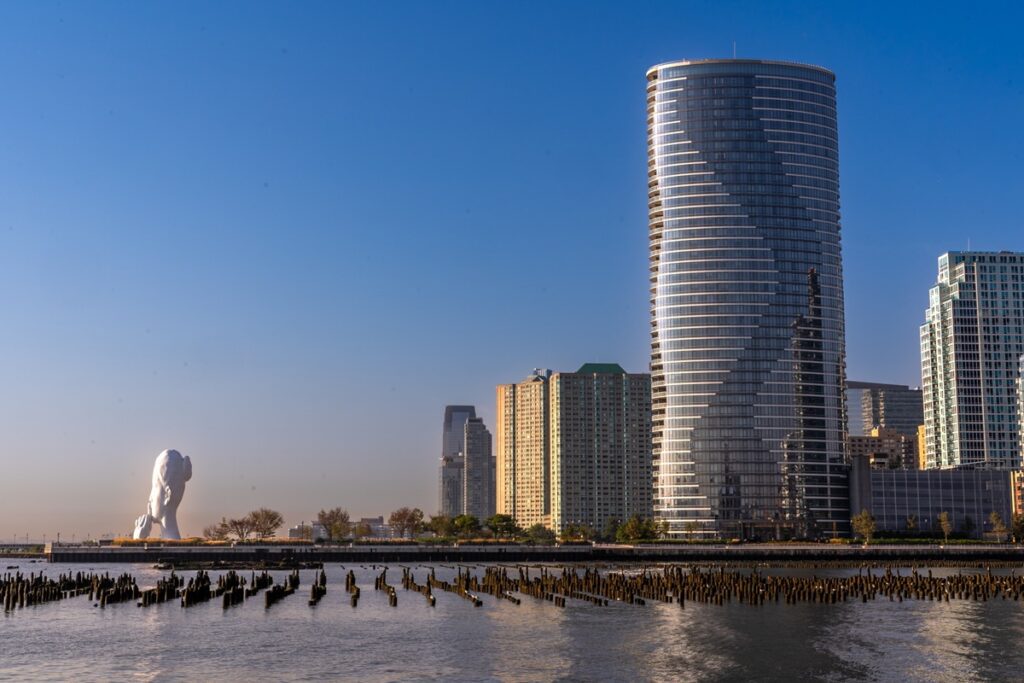

For a long time, Jersey City looked like a city that had outrun its problems.
Development kept coming. New buildings went up along the Hudson. Companies moved in. The population climbed. From the outside, the story seemed straightforward: growth was working.
This week, that story cracked.
A new fiscal report released yesterday by Mayor James Solomon shows Jersey City facing a budget shortfall of roughly $255 million—close to 30 percent of its annual operating budget. The gap is larger than what the city spends each year on police and fire services combined. For a city of about 300,000 people, it’s a staggering number.
The analysis was conducted with the Institute for State and Local Governance at CUNY and arrived just weeks after Moody’s downgraded Jersey City’s bond rating for the second time in three years. In December, the credit-rating agency warned that the steps needed to stabilize the city were becoming “increasingly drastic” and that a clear path to recovery was hard to see.
Even so, the size of the deficit caught many off guard.
Solomon, who took office after Steven Fulop’s 12-year tenure ended, has been blunt about how the city got here. He argues that repeated short-term fixes were used to avoid difficult budget decisions, particularly as Fulop pursued a run for governor before ultimately stepping away from City Hall.
As a City Council member, Solomon voted against the budget every year he served, citing concerns about long-term sustainability. Now, as mayor, he is inheriting the consequences of those choices.
Fulop has pushed back. He disputes the fiscal analysis and says Solomon supported some of the very policies he is now criticizing. Fulop, who last month became president and chief executive of the Partnership for New York City, a powerful business advocacy group, has framed the dispute as a political disagreement rather than a financial reckoning.
What’s hard to ignore is the timing.
For years, Fulop pointed to Jersey City’s growth as evidence that the city was on solid footing. During his gubernatorial campaign, he highlighted the waterfront skyline, the influx of corporations, and the city’s proximity to Manhattan as proof that Jersey City had become an economic engine.
The growth was real. The money, it turns out, didn’t solve everything.
According to the report, revenue growth failed to keep pace with long-term obligations. Temporary measures were used to close gaps. Structural problems accumulated quietly while the city’s reputation continued to improve.
Solomon has already moved to expand the city’s ability to collect a payroll-related tax from employers whose workers live outside Jersey City. A bill backing that effort became law in Trenton last month. It may help narrow the gap. It will not erase it.
What comes next is still taking shape, but the options are limited. Cuts, new revenue, or both now appear unavoidable. For residents, the shift from confidence to crisis has been abrupt. For investors and policymakers, the warning signs were there—just not acted on.
Jersey City still has the skyline. It still has the location. What it no longer has is the benefit of the doubt.

The New Jersey Digest is a new jersey magazine that has chronicled daily life in the Garden State for over 10 years.