


New Jersey electricity bills just jumped 17%. The culprit isn’t just rates—it’s the devices in your home quietly pulling power 24 hours a day.
Walk through your house and count the blinking lights: the router, the TV on standby, the microwave clock, the charger with nothing plugged in. Each one is still drawing electricity—whether you’re using it or not.
Energy researchers call them “vampire devices.” And in a high-cost state like New Jersey, they add up faster than most people realize.
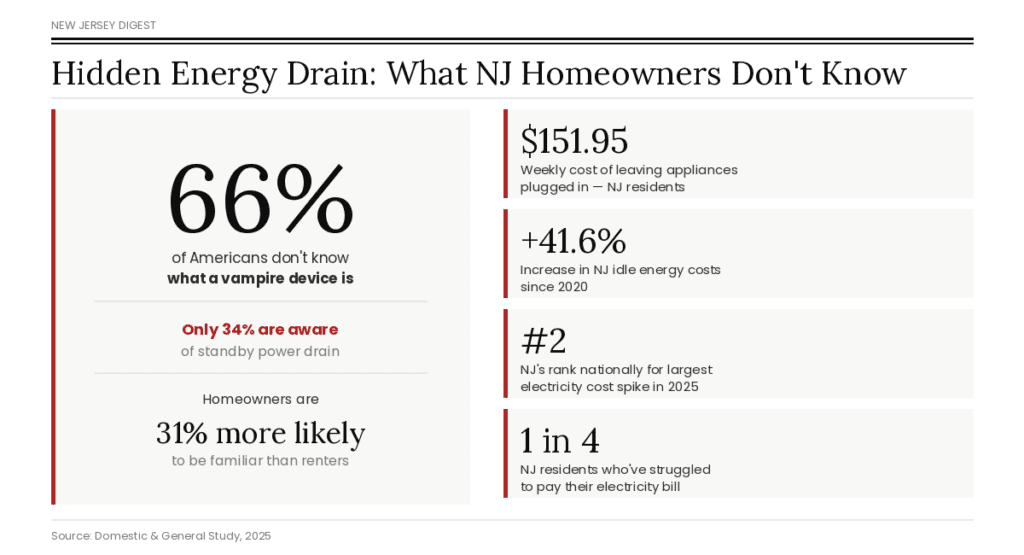
According to a new study by Domestic & General, New Jersey saw a 15.3% spike in idle electricity costs in 2025 alone—the second-largest jump in the entire country. That figure tracks with a recent Joint Economic Committee report showing New Jersey utility bills have surged 17% overall. The only state paying more for a week of idle appliances is New York, where residents shell out $181.60 for the same privilege.
The cruel part? Most people here don’t even know what a vampire device is.
Nearly 3 in 4 New Jersey residents are unfamiliar with the term “vampire device,” meaning the very thing quietly inflating their bill every month doesn’t have a name for them yet.
The $150-a-week problem nobody’s talking about
When researchers asked New Jerseyans which appliance eats the most energy, nearly half—49%—pointed to their air conditioning unit. That’s a reasonable guess. AC is loud, it runs for hours, and you feel it when the bill comes in July. But it’s almost always the wrong answer.
The real culprit is typically the water heater. It works in silence, heats water you may not even use, and keeps that water warm whether you’re showering or sitting at the office. Only 11% of NJ residents guessed correctly. That gap between perception and reality is exactly how vampire devices get away with it — they don’t announce themselves.
The numbers have been creeping up for years. Since 2020, the weekly cost of running idle appliances in New Jersey has risen 41.6%. Maryland, the only state with a bigger 2025 spike than New Jersey (16.1%), saw costs jump 61% over the same five-year stretch. Both states are running well ahead of the national average, and there’s no sign of a slowdown.
What people actually do before a vacation, and what they miss
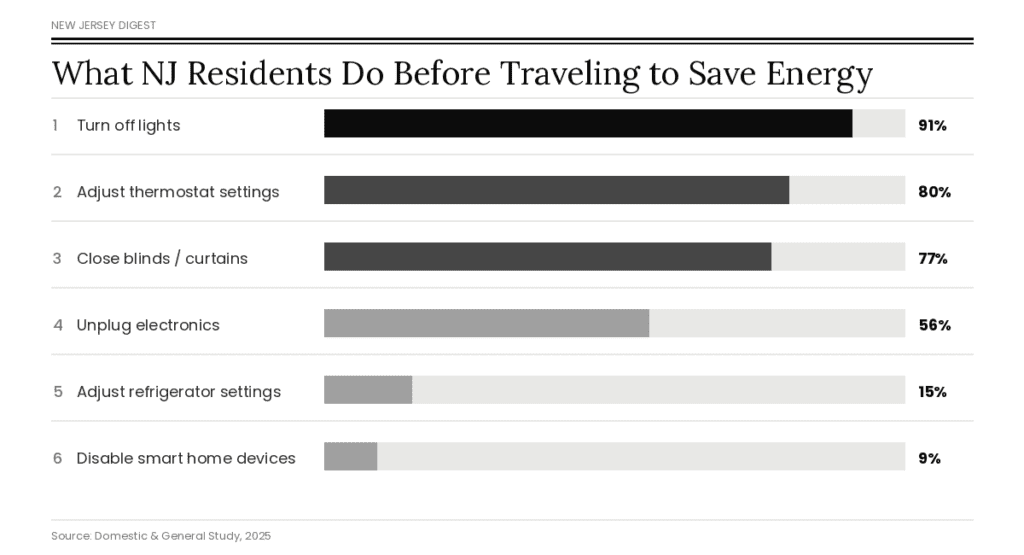
To be fair, New Jerseyans aren’t completely in the dark. When they leave for a trip, most people do take some steps to cut energy use. Ninety-one percent turn off their lights before heading out. Eighty percent adjust the thermostat. Seventy-seven percent close the blinds.
Those habits matter. But they’re also the easy, visible ones: the actions that feel productive because you can see yourself doing them. What almost nobody does before a vacation is go around unplugging electronics. Only 56% of Americans disconnect their devices before traveling, and even fewer, just 9%, disable smart home gadgets that quietly communicate with servers even when everything appears “off.”
More than a quarter of New Jerseyans have struggled to pay the bill
This isn’t just a curiosity. For 26% of New Jersey residents—more than one in four—electricity bills have become difficult to pay at some point in the past year. And 80% of Garden State households say they’re worried their utility costs will climb even higher in the year ahead.
Those fears are not unfounded. New Jersey’s electricity rates are among the most expensive in the region. Maryland follows closely at $150.27 per week for idle appliances. New York leads the northeast at $181.60. All three states are significantly outpacing the rest of the country, and all three saw their sharpest increases in 2025.
The good news: some NJ residents are already adapting
The data isn’t all grim. Over the past year, many New Jerseyans have started making real changes. More than half (58%) have swapped incandescent bulbs for LED alternatives. Nearly half (48%) have gone around their homes sealing air leaks, and 45% have invested in energy-efficient appliances.
Those are meaningful steps. LED bulbs alone can cut lighting costs by up to 75%. Sealed air leaks reduce heating and cooling load. And energy-efficient appliances, while expensive upfront, tend to pay for themselves within a few years at New Jersey’s current rate trajectory.
But until more residents understand what’s actually drawing power when the house looks quiet—the standby modes, the phantom loads, the always-on smart devices—a significant chunk of every electricity bill will keep disappearing without explanation.
Knowing the name “vampire device” is the first step. The second step is a power strip with an on/off switch. The third step is actually flipping it.
What you can do this week
Five moves that actually move the needle:
- Plug your TV, gaming console, and streaming devices into a single smart power strip. One switch cuts phantom load from all of them at once.
- Lower your water heater temperature to 120°F. Most are set to 140°F from the factory — higher than needed and a significant source of idle energy draw.
- Unplug chargers when they’re not actively charging something. A phone charger with nothing attached still pulls power from the wall.
- Check your refrigerator temperature settings. Manufacturers often set them colder than necessary. Aim for 37°F for the fridge, 0°F for the freezer.
- Before any trip, do one quick circuit of the house: unplug what you can, set the thermostat to away mode, and disable smart devices you don’t need running while you’re gone.
New Jersey’s electricity costs are going up. That’s the reality. But the residents who understand where the money actually goes—and take small, specific steps to address it—will be in a meaningfully better position than those who don’t. Vampire devices are a fixable problem. You just have to know they exist first.

The New Jersey Digest is a new jersey magazine that has chronicled daily life in the Garden State for over 10 years.