

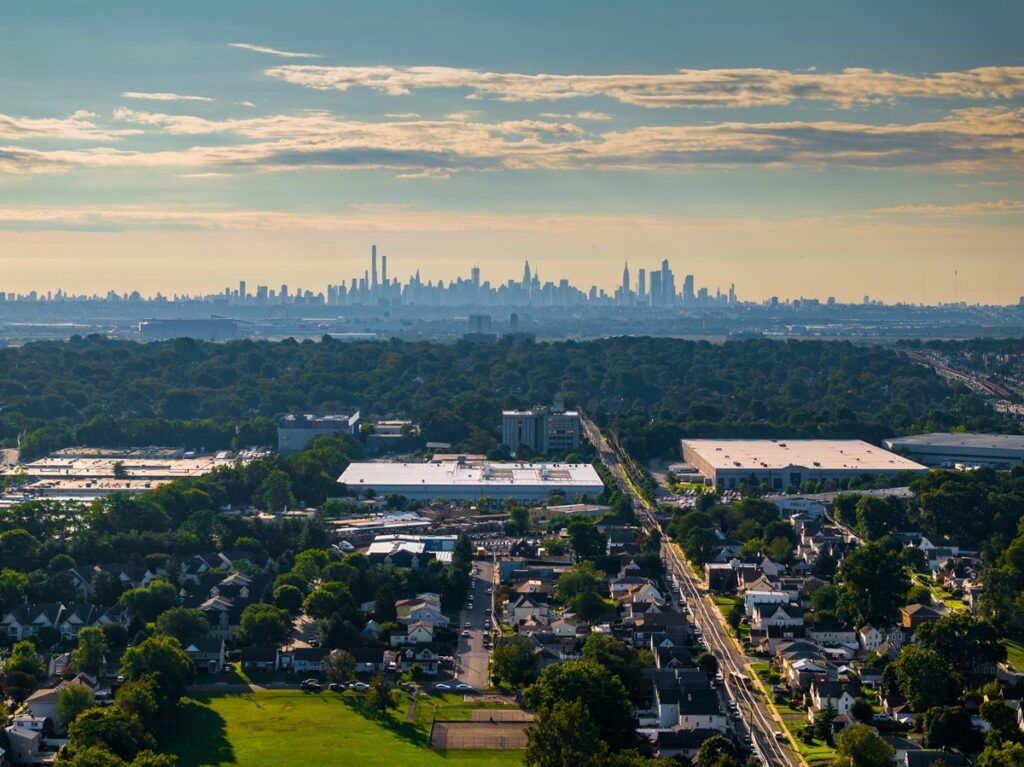

After lists of potential Iranian targets in the United States circulated online last week, some New Jersey residents joked about one thing: the state wasn’t on them.
Last week, as tensions between the United States and Iran dominated headlines, unofficial lists began circulating on social media—purported targets of Iranian strikes on American soil, a mix of major cities and critical infrastructure. For most Americans, it was a moment of grim scrolling. For a loud and vocal subset of New Jerseyans, apparently, it was cause for celebration.
The posts ranged from genuinely relieved to full-on meme territory. “Jersey’s not on it, we’re good!” “LMAO, they don’t even want us!” The jokes wrote themselves. And look—this is Jersey. We have a sense of humor about ourselves. That’s one of our best qualities.
But here’s the thing: only in New Jersey would we celebrate being the filling in a nuclear sandwich. Because that’s exactly what we are. We are a 70-mile-wide state wedged between New York City and Philadelphia—two cities that would, without question, be on any serious list of American targets. And when those cities get hit, the consequences spill over to New Jersey. We don’t get a pass. All this to say, there is no actual target list (and no current threat to the Garden State), which is important to remember.
In a statement Saturday from Mikie Sherrill, the New Jersey Governor clearly stated, “My office is closely monitoring the situation in Iran, Israel, and elsewhere in the Middle East. At this time, there is no known threat to New Jersey.”
Before any of that, though, let’s talk about what Iran can actually do. Because the conversation deserves more than memes.
First, What Can Iran Actually Do?
Let’s get one thing straight: Iran does not currently possess a confirmed nuclear weapon. Its uranium enrichment program has drawn international scrutiny for years, but the consensus among U.S. intelligence agencies is that Iran has not yet built a deployable warhead. That’s the first thing to understand.
The second is range. Iran’s most advanced ballistic missiles—the Shahab-3 and its variants—can reach roughly 1,200 to 1,900 miles. That’s enough to threaten Israel, U.S. military installations in the Middle East, and parts of southeastern Europe. The continental United States sits approximately 6,000 to 6,500 miles away from Iran. The math doesn’t work. There is no Iranian ICBM. Developing one would require technological leaps in propulsion, guidance systems, and re-entry vehicle engineering that Iran simply hasn’t made.
So what does Iran actually threaten? American allies. American bases abroad. And, in the most realistic scenario for domestic harm, asymmetric attacks—terrorism, cyberwarfare, and a radiological dirty bomb delivered not by missile, but by truck.
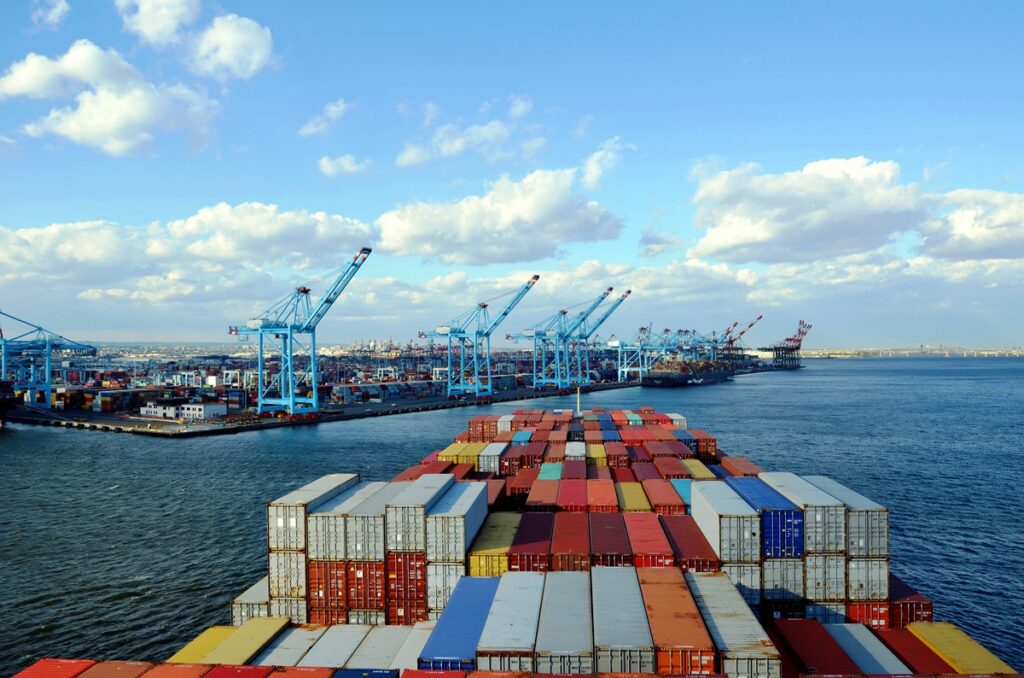
Port Newark-Elizabeth Marine Terminal is one of the largest and busiest ports on the entire Eastern Seaboard. Hundreds of thousands of shipping containers pass through it every year. It is, by any strategic calculus, a prime infrastructure target—and it sits in New Jersey. We’re not just collateral damage in this scenario. We’re potentially the entry point.
The Blast Nobody Mapped For You
Set aside the dirty bomb for a moment and consider the scenario that had people sharing those lists in the first place: a nuclear strike on New York City.
Even a limited attack on a city like New York would not stop at the borough line. New Jersey’s proximity means its infrastructure, transportation networks, and hospitals would immediately feel the impact.
Fallout and other cascading effects from an attack would not respect state lines. Geography alone means large parts of North Jersey would inevitably be affected by events in New York. The wind doesn’t check whether you’re on the list.
The Other Side of the Sandwich
North Jersey gets absorbed into the greater New York conversation so often that we sometimes forget about the other border. But South Jersey exists, and South Jersey is, for all practical purposes, Philadelphia.
Cherry Hill, Voorhees, Moorestown, Haddonfield, Mount Laurel—these aren’t independent communities floating in a geographic vacuum. They are Philadelphia suburbs. Their residents commute to Philly, shop in Philly, and root for the Eagles with a fervor that borders on the religious. Their economy is Philadelphia’s economy. A strike on Philadelphia is, functionally, a strike on South Jersey.
The bridges tell the story. The Ben Franklin, the Walt Whitman, the Tacony-Palmyra—these are the connective tissue between the two places. In the event of a catastrophic attack on Philadelphia, those bridges don’t become escape routes. They become heavily congested with people trying to leave in both directions, rendered impassable within minutes. South Jersey doesn’t get to watch from a safe distance. It gets swallowed.
New Jersey Is Wired Into Both Cities: And That’s the Problem
This is where the “we’re not on the list” logic completely collapses. New Jersey is not merely adjacent to New York City and Philadelphia. New Jersey is structurally integrated with both of them in ways that make separation, in a crisis, essentially impossible.
The power grid doesn’t recognize state lines. Neither does the water supply infrastructure, the transportation network, or the financial system. When either of those cities goes down, the cascading effects hit New Jersey almost simultaneously. Jersey’s hospitals—which, even on a normal Tuesday, operate at or near capacity—would be overwhelmed within hours. Every emergency room from Hackensack University Medical Center to Cooper in Camden would be receiving casualties, it has no bandwidth to treat.
And let’s talk about density. New Jersey is the most densely populated state in the nation. There is no open frontier here, no vast rural hinterland to absorb shock. We are nine million people packed into 8,700 square miles. When something goes wrong at scale, there’s very little physical buffer to absorb a crisis at that scale.
The Potential Refugee Wave (If Something Happened)
Think about the Garden State Parkway on the Friday before Labor Day. Now imagine millions of people trying to leave New York City at once. Many of the most direct routes out funnel through New Jersey, which would quickly strain roads, hospitals, and emergency services. There are eight million people in the five boroughs. Millions more in Westchester, Long Island, and Connecticut.
The psychological and logistical weight of absorbing even a fraction of that displacement is almost impossible to overstate. Food systems would be exhausted within days. Shelters—schools, churches, community centers—would be overwhelmed. The state’s emergency management infrastructure, well-intentioned as it is, was not built for this. No state was. And unlike shore traffic, these people aren’t turning around Sunday night.
The More Likely Scenario Is Actually Worse for Jersey
Here’s the cruel irony: the threat scenario that is actually most realistic—a radiological dirty bomb or a coordinated terror attack on critical infrastructure—doesn’t require a missile at all. It requires a van, a determined actor, and access.
Port Newark-Elizabeth, again, deserves to be said plainly: it is one of the most significant infrastructure chokepoints in the Western Hemisphere. Security experts have flagged vulnerabilities there for decades. A dirty bomb detonated at or near that port would not just cause immediate casualties—it would shut down one of the primary arteries of East Coast commerce for months, potentially years.
Beyond the port: NJ Transit moves hundreds of thousands of people daily. Penn Station Newark is a major hub. The Lincoln and Holland Tunnels are among the most trafficked chokepoints in the country. These aren’t peripheral targets. They are the gateway to the entire Northeast, and they are in New Jersey.
That’s always been a point of pride for us. We’re the gateway. We’re where things move through. What we don’t say out loud is that being the gateway also means being exposed.
So What Should New Jersey Actually Be Doing?
None of this is meant to induce panic. Panic is useless. What this moment calls for is something New Jerseyans are actually pretty good at when we put our minds to it: pragmatism.
The New Jersey Office of Homeland Security and Preparedness (NJOHSP) maintains public resources on emergency preparedness, and they’re worth actually reading. Not in a bunker-building, prepper way — but in the way that any sensible adult who lives in a densely populated state sandwiched between two major American cities probably should. Know your evacuation routes. Understand shelter-in-place protocols. Have a plan for your family that doesn’t rely entirely on cell service, because cell service will be the first thing that goes.
At the state level, the conversation that New Jersey’s elected officials and emergency managers should be having publicly—and loudly—is about regional coordination. NJ’s fate in a major attack on either neighboring city is inseparable from the response capacity of New York State and Pennsylvania. Those mutual aid frameworks need to be robust, tested, and funded. Whether they currently are is a question worth asking your representatives.
For individual preparedness guidance, FEMA’s Ready.gov and NJOHSP’s official site are the right starting points.
We Know Better Than This
Look, the memes were funny. They were very Jersey. And the impulse behind them—the dark humor, the “of course they don’t want us, we’re Jersey” self-deprecation—is genuinely one of the more endearing things about living here. We don’t take ourselves too seriously. We’ve been the butt of the joke long enough to own it.
But being Jersey also means being sharp. It means not being fooled by surface appearances. Not being on the list doesn’t make us safe. It just makes us the neighbors of the people who are. And in New Jersey, we know better than anyone: what happens next door always ends up on your doorstep.

The New Jersey Digest is a new jersey magazine that has chronicled daily life in the Garden State for over 10 years.