

State data shows where every tax dollar lands, why some towns send 80 cents of it to schools, and why a Shore mansion can pay less than a Cape Cod in Morris County.
The property tax bill shows up, somebody in the house says something unprintable, and the next Town Council meeting fills up with people asking why the mayor needs another police car. Believe it or not, in most cases, the mayor isn’t the main problem. Neither is the county. In most of New Jersey, the biggest share of your property tax bill goes to a budget your town council doesn’t control at all: the school district.
Where the Money Goes
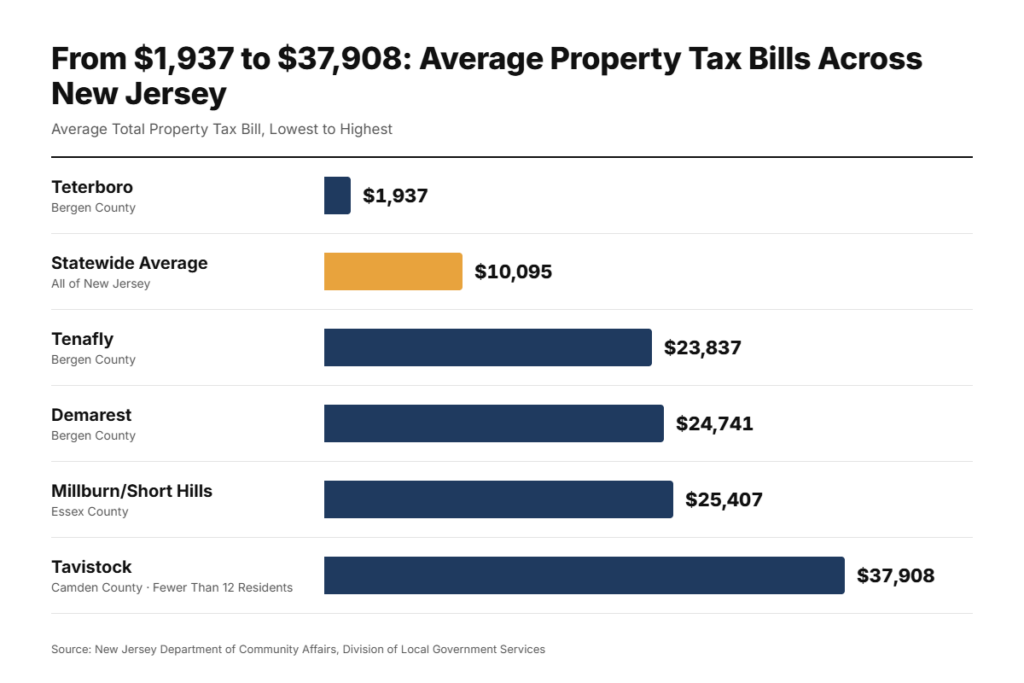
New Jersey’s average property tax bill is now $10,095, according to the state Department of Community Affairs. That’s the first time the statewide average has topped $10,000, before any state credits or deductions.
Here’s how that bill breaks down across the state’s 564 municipalities:
Where It Goes Share of the Average Bill Public schools 52.2% Municipal government 29.9% County government 17.9%
So for every dollar, about 52 cents goes to schools. Police, fire, public works, parks, and everything else town hall runs split less than 30 cents. The county gets the rest.
Statewide, property owners pay more than $33.3 billion a year in property taxes. Roughly $17.5 billion of that is levied for school districts alone.
That’s the number driving the bill past $10,000 and not town hall salaries. School budgets.
The $15,000 School Tax Club
In some North Jersey suburbs, the school portion of the tax bill alone is more than a lot of people pay for a car every year.
Town Average Total Tax Bill Average School Share Mountain Lakes (Morris) Not listed $15,750 Millburn/Short Hills (Essex) $25,407 More than $14,500 Demarest (Bergen) $24,741 More than $14,000 Tenafly (Bergen) $23,837 About $13,800
Mountain Lakes has the highest school tax bill in New Jersey, averaging $15,750 per household for local and regional schools. It’s the same Mountain Lakes that just ranked fourth on Niche’s list of the best places to live in the state, with an A+ school district. Residents get the schools. They also get the bill.
Millburn, which includes Short Hills, has the highest average total property tax bill of any traditional New Jersey town at $25,407. More than $14,500 of it goes to schools.
These districts are some of the best in the country, and that reputation is a big part of why homes there cost what they do. It isn’t free. The prestige is funded one tax bill at a time.
Why Shamong Sends 80 Cents to Schools
Shamong Township in Burlington County sends 80.5 percent of its property tax levy to schools, the highest share in the state.
The reason is what Shamong doesn’t have. No big shopping corridors, no office parks, no warehouses, no major highways lined with businesses paying taxes. In towns that have those, commercial property owners pick up a share of the school bill. Tax people call them ratables.
In a town with almost no commercial ratables, nobody else is there to split the cost. Homeowners pay nearly all of it.
Teterboro is the opposite extreme. The Bergen County borough has the lowest average residential tax bill in New Jersey at $1,937, because Teterboro Airport and a dense cluster of industrial and logistics properties carry most of the load.
And then there’s Tavistock in Camden County, which has the state’s highest average bill at $37,908. Before anyone panics, Tavistock is basically a private golf club with fewer than a dozen residents. It’s a statistical oddity, not a warning sign.
The Shore Town Math
Avalon and Stone Harbor have some of the lowest effective property tax rates in New Jersey, about 0.37 percent in Avalon and 0.44 percent in Stone Harbor.
That seems backward until you think about who lives there. Shore towns are packed with expensive vacation homes, which gives them an enormous tax base. But second-home owners rarely send kids to the local public schools. Small school enrollment plus a huge property base means a very low rate.
The result is that a multimillion-dollar house on the beach in Cape May County can pay a smaller share of its value in school taxes than a modest house in Morris or Bergen County.
How to Read Your Own Bill
Pull out your property tax bill and look for two lines: “Local School Tax” and, if your town is part of a regional district, “Regional School Tax.” Add them up and compare that number to the “Municipal Tax” and “County Tax” lines. For most people in New Jersey, the school lines will be the biggest.
The state’s own figures are available through the Department of Community Affairs’ property tax data and the Department of Education school district budget statements if you want to see your town’s breakdown.
If the school number is what bothers you, the town council isn’t the right room. School board elections and school budget votes are where the biggest share of your property tax gets decided, and turnout for those is usually a fraction of what shows up for a mayor’s race.
The New Jersey Digest is a new jersey magazine that has chronicled daily life in the Garden State for over 10 years.
