

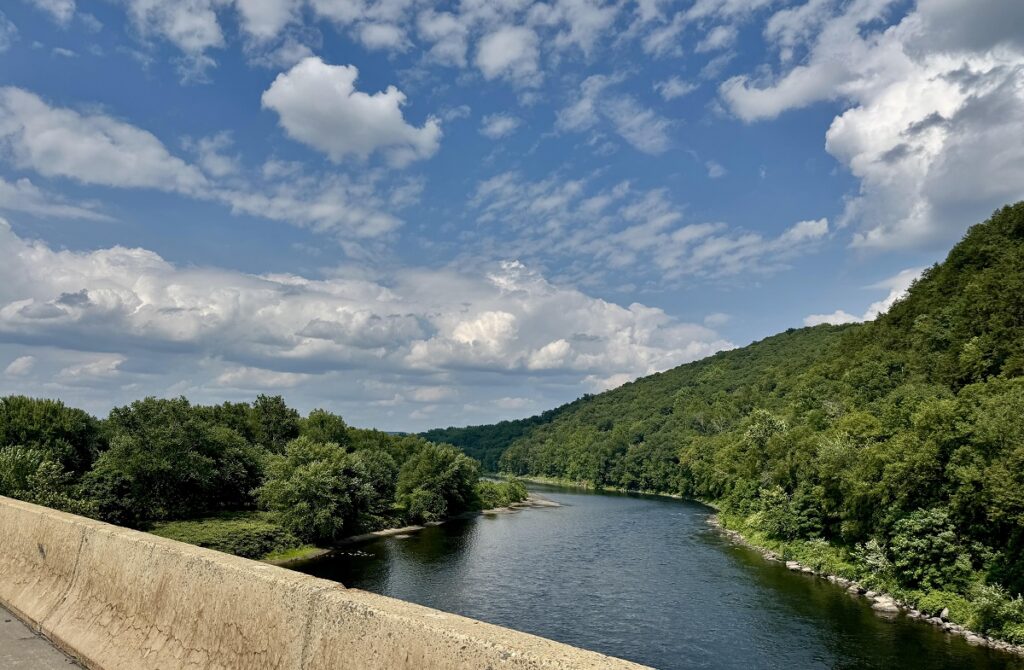

A study tested the Delaware River and Philadelphia-area creeks between 2022 and 2024. The results were not close.
Pull up a map of New Jersey and draw a line across Trenton. Everything south of that line, the Pine Barrens, the farm counties, the shore towns, the aquifer that a million people drink from. In 98 percent of the waterways tested down there, researchers found PFAS chemicals. We’re not tlaking about small traces or little, insignifcant pockets that are isolated. 98 percent.
Statewide it was 91. On the Pennsylvania side, it came in at 96. The study ran from 2022 to 2024, covering the Delaware River and a range of Philadelphia-area creeks, and was put together by PennEnvironment Research & Policy Center, the Environment New Jersey Research & Policy Center, and Frontier Group.
“Our waterways should be clean and free of toxic chemicals,” says Doug O’Malley, state director for Environment New Jersey Research & Policy Center. “Yet PFAS contamination of our rivers and streams is widespread.”
In addition, anyone catching and eating fish. Remember, people fish the Delaware. People fish the Raritan and the Mullica and the Maurice. This is not hypothetical exposure we’re talking about.
On top of that, earlier this year we learned roughly 4,000 NJ homes have been drinking toxic water at home.
What They Are and Why They’re Everywhere
PFAS, per- and polyfluoroalkyl substances, have been manufactured since the 1940s. Thousands of different compounds fall under the umbrella. They went into nonstick pans, food packaging, waterproof clothing, firefighting foam, stain-resistant carpet. Industry liked them because they worked and they lasted. That durability is exactly the problem.
They don’t break down. Not in soil, not in water, not in the body. You eat them, they stay. Fish eat them, they stay and concentrate. The food chain moves them upward. Forever chemicals is not a metaphor.
Two of the most studied variants, PFOA and PFOS, have been phased out in the U.S. and replaced with newer PFAS compounds. The research on what those replacements do to human health is still catching up to their deployment, which is a pattern the chemical industry has run before and which should bother you.
How It Gets Into You
Contaminated drinking water is the main route, both public systems and private wells. Eating fish from affected waterways. Soil and dust near landfills and industrial sites. Air near manufacturing facilities. Products that contain PFAS or are wrapped in materials that do.
CDC surveys show most Americans carry some PFAS load in their bodies already. For most people it’s low. For people near a concentrated source, a contaminated well, a military base that used firefighting foam for decades, an industrial site, it gets considerably higher. And because these chemicals accumulate rather than clear out, time spent near a source matters as much as the concentration itself.
What It Does
The EPA links PFAS to cancer. Also to reproductive complications, liver and kidney stress, suppressed immune response, and developmental problems in children. The research is ongoing and the full picture at low chronic exposure levels, which is what most New Jerseyans in contaminated areas are actually dealing with, is still being assembled. That incompleteness is not reassurance. It means we’re living the study.
Kids are the sharpest concern because their bodies are still developing and because whatever they absorb now they carry for a long time.
The South Jersey Number
Ninety-eight percent is not a rounding error. South Jersey sits on top of the Kirkwood-Cohansey Aquifer, a shallow, historically clean groundwater source that supplies drinking water to over a million people and irrigates a big share of the state’s farmland. We’ve written about this aquifer before in the context of the data center going up in Vineland. The issue keeps coming back to the same ground.
Shallow means vulnerable. PFAS that make it through soil reach groundwater and they do not stay put. They travel. Surface water contamination at 98 percent and aquifer protection are not separate conversations for South Jersey.
What You Can Actually Do
The EPA set new maximum contaminant levels for several PFAS compounds in drinking water in 2024. Public utilities are working out compliance timelines and are increasingly required to publish their testing results. Look yours up. Most New Jersey water providers have this posted or will provide it on request.
Private well owners are in a different situation. The regulations that govern public systems don’t automatically reach your well. If you’re on a private well in South Jersey and you haven’t tested for PFAS, that is the next thing to do. The state offers resources and some counties have testing programs. It is not complicated. It is just easy to put off, which is how a lot of people end up drinking contaminated water for years without knowing it.
The study doesn’t offer a fix. What it offers is a number, and 91 percent is too large a number to treat as isolated or occasional. This is not a story about a single Superfund site or one bad municipal system. It’s about the baseline condition of the water in the ground and running through the rivers of two states, one of which is the most densely populated in the country and happens to grow a significant amount of its own food.

The New Jersey Digest is a new jersey magazine that has chronicled daily life in the Garden State for over 10 years.