

FIFA is canceling thousands of hotel bookings across World Cup host cities—including rooms tied to the New York–New Jersey region. What’s less clear, because FIFA hasn’t been direct about it, is why. The answer isn’t one thing. It’s five, and they’re happening at the same time.
The Contract Clause Nobody Talked About
Start with the mechanics. When FIFA locks up hotel inventory for a World Cup, it does so years in advance and in enormous volume—far more rooms than it will realistically need. That’s intentional. The blocks function as insurance: guarantee availability, then release what you don’t use once operational plans sharpen.
Built into those contracts is a window—typically around 120 days before the tournament opens—during which FIFA can relinquish unused inventory without financial penalty. That window opened this month. FIFA exercised it in Philadelphia, releasing roughly 2,000 of 10,000 reserved rooms. It exercised it in Mexico City, where it cut approximately 40% of its bookings. Boston and Toronto have seen it too. This is not a crisis; it’s a clause. FIFA has done this at every modern World Cup. The difference this time is the size of the releases and the context surrounding them. For a deeper look at how FIFA’s room releases hit New Jersey specifically, see our earlier reporting here.
Demand Hasn’t Matched the Hype
FIFA projected between five and six and a half million fans attending matches across the U.S., Canada, and Mexico. Those numbers drove cities, hotels, and local economies to build their entire summer around an assumed surge. The problem is that actual booking behavior hasn’t kept pace with those projections—at least not yet.
The CEO of the American Hotel and Lodging Association said plainly that World Cup demand has not fully translated into strong hotel bookings at this stage. Hotels that planned around near-full occupancy are now in a holding pattern, hoping the surge comes closer to kickoff. It may. Last-minute travel is common for soccer fans, particularly those following teams that advance deep into the tournament—you don’t book a flight to the quarterfinals until your country makes the quarterfinals. But the gap between what was projected and what’s been booked so far is real, and FIFA’s room releases reflect that recalibration.
Visas, Costs, and a Chilling Effect on International Travel
Here’s where it gets more complicated. The World Cup was always going to depend heavily on international visitors—fans from Brazil, Argentina, Morocco, Portugal, England, and dozens of other competing nations willing to spend real money to see their teams play on a global stage. That pipeline has developed friction.
Fans from a list that has grown to 50 countries now face a $15,000 bond requirement to apply for a U.S. tourist visa. Visa processing times are lengthy. Travel costs are climbing. And the announcement that ICE would have a presence at World Cup matches added a layer of uncertainty that no amount of FIFA marketing can fully offset. A Brazilian fan who spent over $40,000 attending the last World Cup told a German outlet he is more concerned this time around—not about the soccer, but about the surrounding environment. He is not alone in that calculation. These aren’t fringe concerns. They are suppressing the international travel numbers that host cities were counting on.
The $100 Million Budget Cut
FIFA’s operating budget for this tournament was slashed by $100 million. That cut touches safety, logistics, security, and accessibility infrastructure. It also factors into how lean FIFA is running its operational hotel footprint. When you reduce the size of your traveling organization—staff, officials, delegates, media operations—you need fewer guaranteed rooms. The room releases in host cities are partly a downstream consequence of a leaner organizational structure than originally planned.
Federal Security Funding Still Hasn’t Landed
In New Jersey and across multiple host cities, fan festivals were scaled back or scrapped after federal security funding stalled in bureaucratic limbo. That money—meant to cover police overtime and event security costs—was supposed to anchor the community experience around the tournament. Without it, the street-level momentum that builds hotel demand, fills restaurants, and drives the economic multiplier effect of a major sporting event got quieter. New Jersey lost its Liberty State Park festival entirely. When you reduce the ecosystem around the tournament, you reduce the reason for casual visitors to extend their stays.
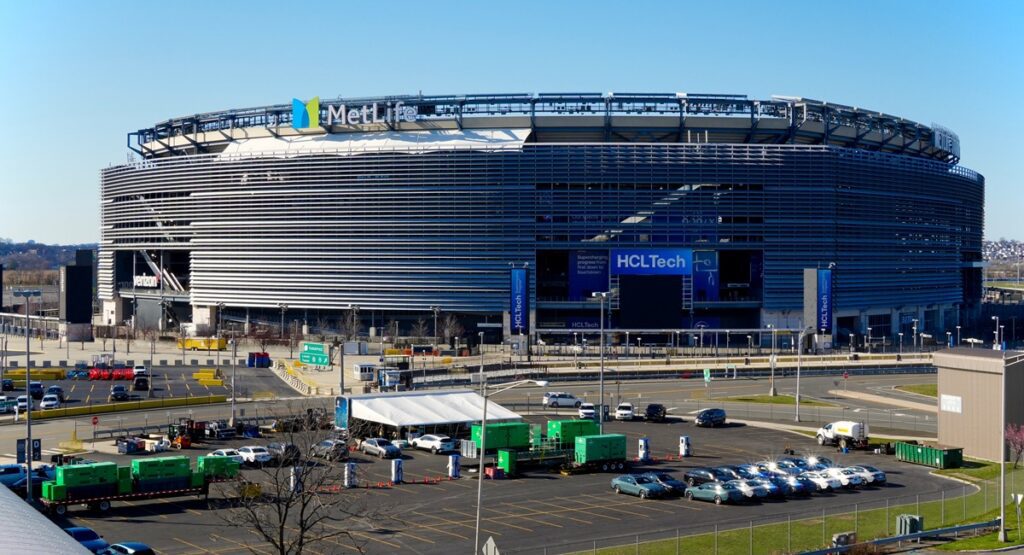
What This Means If You’re Staying Near MetLife Stadium
The rooms released by FIFA are going back onto the open market. For fans who haven’t booked yet, that’s actually useful—it puts inventory into circulation that was previously locked. For hotels in the New Jersey corridor, the situation cuts both ways. More rooms available means more competition for a customer base that, by multiple signals, is booking more cautiously and more last-minute than expected.
The New Jersey market is in a specific bind because of the short-term rental restrictions across so many nearby municipalities—detailed in our previous reporting—that have pushed accommodation pressure entirely onto the hotel sector. NYC’s Airbnb market effectively collapsed under Local Law 18. Now a meaningful share of the hotel supply that was meant to serve the region was being held off the market by FIFA and is only now being released. For fans who do come—and there will be a lot of them, particularly for the Final—the scramble for rooms in the weeks leading up to July 19 could be significant.
The professional read from those inside the industry is cautious optimism. The rooms will sell. The tournament will draw crowds. But the version of the World Cup that lands on New Jersey’s doorstep this summer is a more compressed, more last-minute, more uncertain event than the one that was promised two years ago—and that gap is exactly what these hotel cancellations are measuring.

The New Jersey Digest is a new jersey magazine that has chronicled daily life in the Garden State for over 10 years.
