

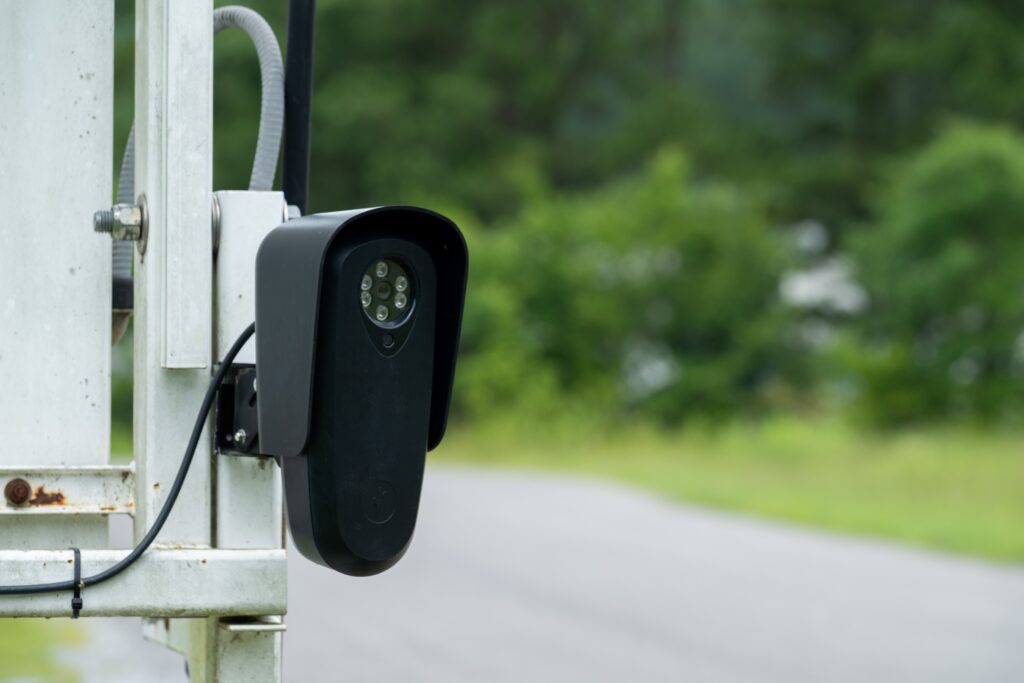
Strategically placed cameras are watching your every move, but most people don’t even know where to look for them.
New Jersey residents are becoming increasingly skeptical of Flock cameras—automated license plate reading (ALPR) and vehicle-tracking systems that have made national headlines in recent months.
Flock—an Atlanta-based company—makes cameras that use AI to read and log license plates, along with a vehicle’s make, model, color, and even bumper stickers or scratches. The data gets uploaded into a database that law enforcement agencies with a Flock contract can search.
The company says it has nearly 100,000 cameras installed across more than 6,000 communities in 49 states.
Princeton Fights Back
In Princeton, a Poe Road resident named Chris Potts has launched a petition asking the town council to ban Flock cameras outright, along with regular ALPRs more broadly, according to Patch. The petition calls for public disclosure of any existing camera locations and data-sharing agreements, and a public hearing before similar technology gets installed in the future.
There’s just one issue: Princeton doesn’t actually use Flock cameras. Princeton Police Chief Matthew Solovay confirmed the department uses ALPR technology, but not Flock’s specific system. “Our use of ALPR technology is governed by applicable New Jersey Attorney General guidelines and directives,” Solovay said, adding that oversight also comes from the Mercer County Prosecutor’s Office and New Jersey State Police.
Potts has stood by the broader concern regardless of which specific company’s cameras are involved. “I don’t think wanting privacy and wanting safety have to be at odds,” he wrote in a letter to the Town Topics. “Princeton can be a safe town without becoming one more data point in a nationwide surveillance network we never agreed to join.”
As of August 11, his petition had 93 of the 100 signatures needed before it goes to the mayor and council.
South Jersey Organizes
While Princeton’s fight centers on a technology that isn’t actually there, Camden County is dealing with cameras that are. A group called DeFlock South Jersey has formed to push for the removal of Flock cameras until stronger oversight exists.
“This is becoming just a really dragnet surveillance, intrusive privacy thing that didn’t exist even two or three years ago,” organizer Adam Sheridan told CBS News Philadelphia. Flock wouldn’t disclose how many cameras operate in Camden County or which agencies use them, though the crowdsourced site DeFlock.org lets residents report camera locations themselves.
Flock maintains its cameras serve a real public safety purpose, pointing to more than 10,000 missing people the company says it helped locate in 2025. The company also says data is automatically deleted after 30 days unless an agency sets a different retention policy, and that agencies retain full control and ownership of their own data.
Concerned Citizens Built a Map
Since companies like Flock generally won’t disclose exactly where their cameras are installed or which departments use them, residents have had to build that picture themselves. DeFlock.org is a crowdsourced map where anyone can report a camera’s location, creating a public record that neither the companies nor most local governments have volunteered on their own.
Zoom in on New Jersey and the density is hard to miss. Cameras—which are user-reported—are heavily clustered around the Northeastern part of the state, spilling into New York City. You see the same density of cameras around the Philadelphia metro, with a steady thread of reports running down the Turnpike corridor toward the Shore and Atlantic City.
Passaic Takes the Opposite Side
Not every New Jersey city is backing away from the technology. According to PIX11, Passaic Mayor Hector Lora has publicly embraced Flock cameras, crediting them with helping police track and dismantle car theft rings that moved between South Jersey, Passaic, Newark, and Wayne.
“I’m considering actually putting up signs that say, smile you’re on camera,” Lora said, arguing transparency could deter thieves before they ever commit the crime.
But it’s that exact kind of inter-municipality data sharing that worries civil liberties advocates. “Law enforcement agencies often have free rein to choose who they share this data with,” said Dillon Reisman, staff attorney for the ACLU of New Jersey. New Jersey’s Attorney General’s office does set guidelines limiting ALPR data access to active investigations, and the state retains data for three years, longer than most states, according to Reisman, who noted many states hold data for only weeks or even minutes.
Reisman also pointed to documented misuse nationally, including cases of officers using the cameras to track ex-partners, and instances of data being shared with ICE to locate immigrants.
Flock Faces Nationwide Scrutiny
New Jersey’s tension with the technology mirrors a national one. Cities across the U.S.—Austin, Cambridge, Santa Cruz, and Eugene—have canceled Flock contracts or deactivated cameras altogether. Ypsilanti, Michigan took an even bolder approach, banning ALPRs entirely. The ACLU has pushed for legislation nationwide to set clearer guardrails around data retention, sharing, and access.
Flock has said it supports legislation establishing those kinds of guardrails, and maintains that public safety and privacy “can coexist.” Whether New Jersey residents agree may depend largely on where they live, and whether they even know the cameras are there in the first place.
For now, in the words of Mayor Lora: smile, you’re on camera.

The New Jersey Digest is a new jersey magazine that has chronicled daily life in the Garden State for over 10 years.
