

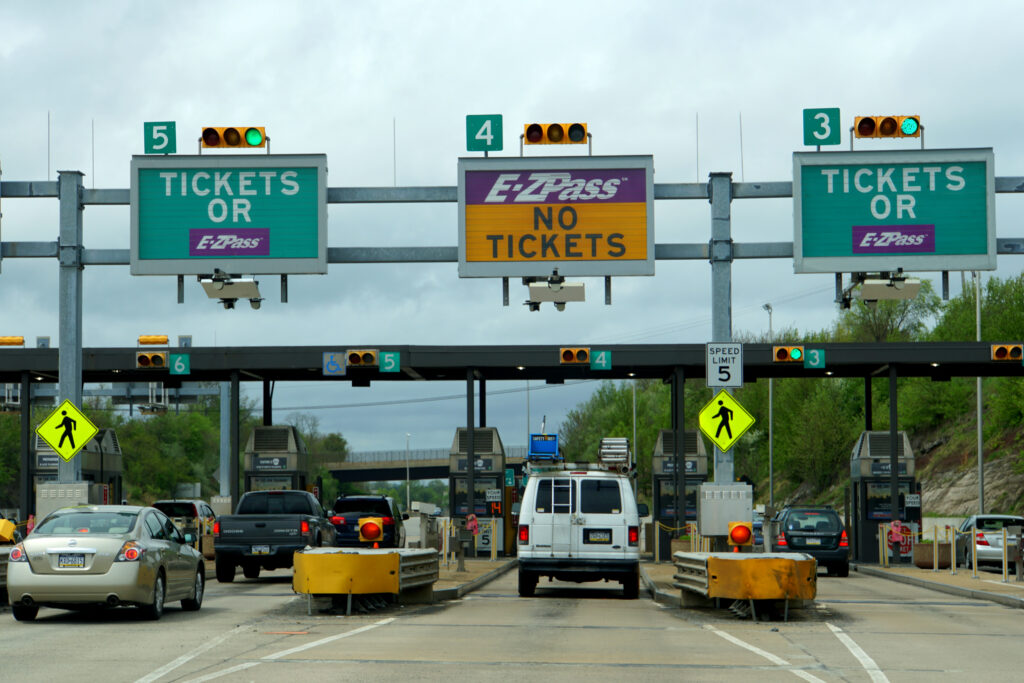
The Turnpike, the Parkway, the AC Expressway, the bridges to Pennsylvania and New York. And if you don’t have an E-ZPass, it’s a lot worse.
There’s no such thing as a quick drive in New Jersey anymore. Not a cheap one, anyway. Down the Parkway for the weekend, over the bridge to see a show, up the Turnpike to your sister’s place for Sunday dinner. Every one of those trips got more expensive on Jan. 1, and most people only noticed when the E-ZPass statement came in.
It’s not one big hike. It’s a few cents here, half a dollar there, spread across every agency that owns a road or a bridge in this state. Add it up and it’s real money.
The Turnpike and Parkway Raise Tolls on Autopilot
Tolls on the New Jersey Turnpike and Garden State Parkway went up 3 percent on Jan. 1. They’ll likely go up again next Jan. 1, and the one after that.
That’s because the New Jersey Turnpike Authority adopted a policy in 2020 that allows tolls to rise up to 3 percent every year. The Legislature doesn’t vote on it, and there’s no new round of public hearings as long as the increase stays within that formula. The authority’s board approves it as part of the annual budget, and the governor can veto the board’s actions, but in practice the increase just shows up on the calendar.
The Turnpike Authority likes to describe it as a few cents per toll plaza, and for any single trip that’s true. The average Turnpike toll went up about 15 cents. A Parkway mainline barrier, the big ones like Raritan, Essex, and Asbury Park, now runs about $2.30 with E-ZPass, up roughly 8 cents. Exit and entrance ramps sit between 76 and 83 cents.
The problem is that 3 percent stacks. Each year’s increase gets added on top of last year’s higher toll, so the cost climbs a little faster every time. A full-length Turnpike trip now costs about $21 with a New Jersey E-ZPass.
If You Don’t Have E-ZPass, You’re Paying Double
The biggest increases this year didn’t hit commuters. They hit people who drive a toll road a few times a year and never bothered with a transponder.
The Atlantic City Expressway went fully cashless on Jan. 4. There are no booths and no option to pay at the plaza. Driving the whole 44 miles from Route 42 to Atlantic City costs about $6.80 with E-ZPass. Without one, the bill comes in the mail at $13.60, plus a $1 monthly invoice fee. That’s twice the price for the same stretch of road.
The Delaware River Joint Toll Bridge Commission raised tolls on Jan. 1 at its eight toll bridges into Pennsylvania, including the I-80 bridge at the Delaware Water Gap, I-78, the Trenton-Morrisville bridge on Route 1, and Scudder Falls on I-295. The E-ZPass toll going into Pennsylvania went from $1.50 to $2. Toll-by-plate went from $3 to $5.
Then there’s New York. The Port Authority raised tolls Jan. 4 on all six of its crossings, the George Washington Bridge, the Lincoln and Holland tunnels, and the Goethals, Bayonne, and Outerbridge Crossing.
Port Authority Crossings, Into New York Toll E-ZPass, peak $16.79 E-ZPass, off-peak $14.73 to $14.79 E-ZPass account, plate read instead of tag $19.55 No E-ZPass, billed by mail $23.05 to $23.30
That third line catches people who do everything right except where they stick the tag. If your E-ZPass is in the glove box, the cupholder, or sliding around the dashboard and the camera has to read your plate, the Port Authority charges you a middle rate of $19.55 instead of the E-ZPass price.
The one agency in the region that didn’t raise tolls this year is the Delaware River Port Authority. Its four bridges between South Jersey and Philadelphia stayed at $6.
What It Costs in Real Life
Toll schedules are hard to picture, so here’s what it looks like for a few ordinary trips.
A weekend down the Shore. A family from Bergen or Essex County heading down the Parkway to Ocean County or Cape May hits four to six mainline barriers each way, plus ramp tolls. That round trip runs roughly $20 to $28 in tolls. Do it six or seven times a summer and that’s around $175 before gas, beach badges, or a single slice of pizza on the boardwalk.
A Saturday night in the city. Taking the GWB or the Lincoln Tunnel to see a show costs $16.79 with E-ZPass at the weekend peak rate, $19.55 if your tag doesn’t read, and $23.30 if you don’t have one at all. Heading into Lower Manhattan through the Holland Tunnel at peak hours also triggers New York’s congestion charge, $9 with a $3 credit for the tunnel toll you already paid. That puts the E-ZPass total at $22.79 to get across the river.
The everyday errand runner. Plenty of people in Central Jersey hop on the Turnpike or Parkway two or three times a week for practices, appointments, or a Costco run. At about $4.80 for an average Turnpike trip or $2.30 per Parkway barrier, three short highway trips a week add up to roughly $60 to $70 a month. Over a year that’s $700 to $850 in tolls for a household that never once drives to an office.
What You Can Actually Do
Get an E-ZPass if you don’t have one. Even if you only use toll roads a few times a year, the mail-billing rates on the AC Expressway, the Delaware River bridges, and the Port Authority crossings are steep enough that a tag pays for itself fast.
Mount it where it belongs, on the windshield behind the rearview mirror. A tag that doesn’t read on a Port Authority crossing costs you nearly $3 extra every time.
And check your statement. Billing errors happen, and nobody’s going to catch them for you.
And It’s Not Just Tolls
Tolls are only part of what it costs to drive in New Jersey. The gas tax is adjusted every year too, and electric vehicle owners now pay an annual registration fee that’s set to climb each year. Whatever you drive, wherever you’re headed, the meter is running.

The New Jersey Digest is a new jersey magazine that has chronicled daily life in the Garden State for over 10 years.
