

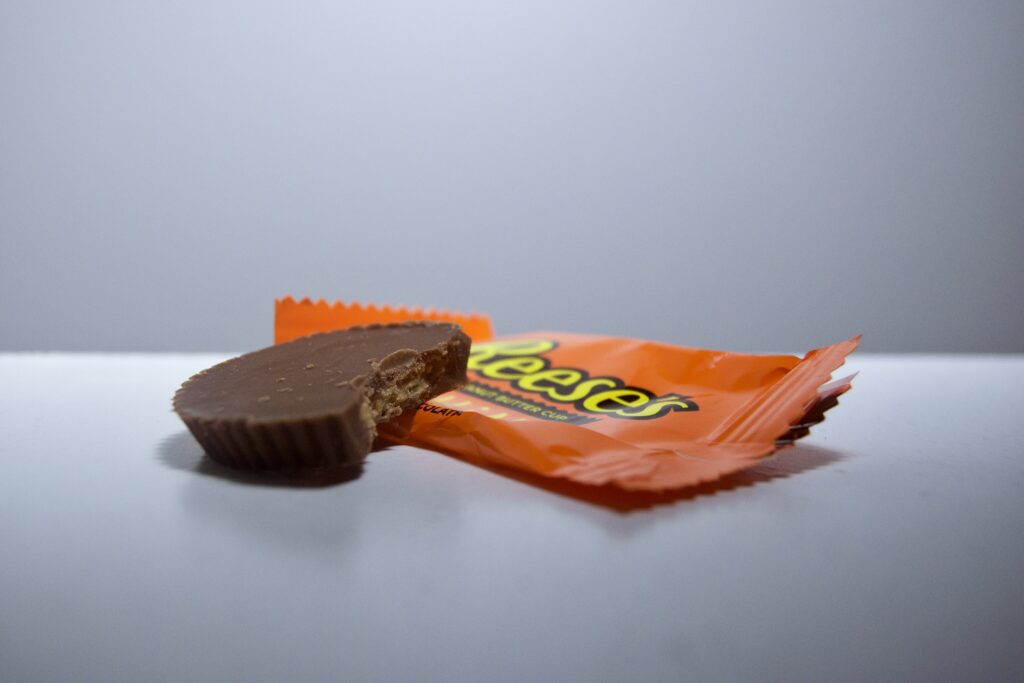

An heir to the Reese’s empire alleges the chocolate and peanut butter treat is not what it once was. Literally.
Brad Reese, grandson of Reese’s inventor H.B. Reese, publicly accused Hershey of quietly replacing real chocolate and peanut butter in certain Reese’s products—a claim he says affects several Reese’s products.
In a LinkedIn post, Reese claims that the Hershey Company has swapped out real milk chocolate for a compound chocolate coating and peanut butter with a peanut butter creme across multiple brand products. “REESE’S identity is being rewritten, not by storytellers, but by formulation decisions that replace Milk Chocolate with compound coatings and Peanut Butter with peanut-butter-style crèmes across multiple REESE’S products,” he wrote.
Reese goes on to allege that the secrecy of such changes erodes consumer trust. “How does The Hershey Company continue to position REESE’S as its flagship brand, a symbol of trust, quality and leadership, while quietly replacing the very ingredients (Milk Chocolate + Peanut Butter) that built REESE’S trust in the first place?” he said.
Hershey responded.
According to CBS News, Hershey acknowledged making recipe adjustments to certain Reese’s products, but reassured consumers that the original Reese’s Peanut Butter Cups are still made the same way they always have been. Hershey said that as the brand evolves, adjustments are made to keep innovation at the forefront.

However, Reese isn’t convinced. In an interview with the Associated Press, Reese said that a bag of Reese’s Mini Hearts—a new product released for Valentine’s Day this year—was the catalyst for his disappointment. As an expert on the candy, he alleges the taste is not there. Upon checking the packaging, the label confirmed his suspicion: “milk chocolate” and “peanut butter” were absent. Instead, “chocolate candy” and “peanut butter crème” took their place.
The FDA is strict when it comes to chocolate labeling—any product that uses less than 10% chocolate liquor, 12% milk solids, and 3.39% milk fat cannot be legally labeled “milk chocolate.” So, when product labels say things like “chocolate candy” or “chocolate product,” it means the item does not meet the FDA’s definition of true milk chocolate.
The accusations caused a rift in the Hershey family, prompting Reese’s cousin Becky Hilgers to reach out. The New York Post obtained text messages between Hilgers and Reese, where she criticized his accusations, writing, “You have created a nightmare for our family and the company.” She went on to suggest that he could face legal consequences, claiming his “unfounded comments” affected the stock price and embarrassed the entire Reese’s clan.
“He walks around everywhere he goes with a Reese’s jacket on just so people will make conversation with him. He’s bitter because his father blew through all the money he got and there was nothing left for his children,” she later said.
Hershey stresses that their flagship Reese’s Peanut Butter Cups have not changed. However, multiple products in the Reese’s line have, according to Reese. He alleges White Chocolate Cups are made with “white creme” now, and Take5—my personal favorite of the bunch—are no longer coated with true milk chocolate.
The Legacy Behind Reese’s
H.B. Reese, a former Hershey employee, founded the Reese Candy Company in 1919, but his claim to fame came in 1928 when he invented the Reese’s Peanut Butter Cup.
The candy quickly became a favorite. His sons sold the brand name to Hershey in 1963, completing the circle.
In the 2000s, Hershey began to rapidly expand the Reese’s product line, while still sticking to the core ingredients: real chocolate and peanut butter. Hershey has acknowledged adjusting certain product formulas in recent years.
One thing is for sure. Reese’s Peanut Butter Cups—arguably the most important product under the Hershey label—have not changed. And they shouldn’t. For Reese, he just wants to see that same commitment to quality across the board.
And he might have a point. As Milton Hershey famously once said: “Give them quality, that’s the best advertising.”

Peter Candia is the Food + Drink Editor at New Jersey Digest. A graduate of The Culinary Institute of America, Peter found a passion for writing midway through school and never looked back. He is a former line cook, server and bartender at top-rated restaurants in the tri-state area. In addition to food, Peter enjoys politics, music, sports and anything New Jersey.
