


For years, the Glassboro-Camden Light Rail has lived in that familiar New Jersey space between “coming soon” and “never happening.” Another study. Another meeting. Another argument at a town council microphone.
Now something different has happened.
Not a vote. Not a presentation. Actual movement.
In recent weeks, agencies involved in the $2 billion rail project began advancing bridge work and approved the first property directly tied to the line. That matters, because once land starts changing hands, projects tend to stop being theoretical.
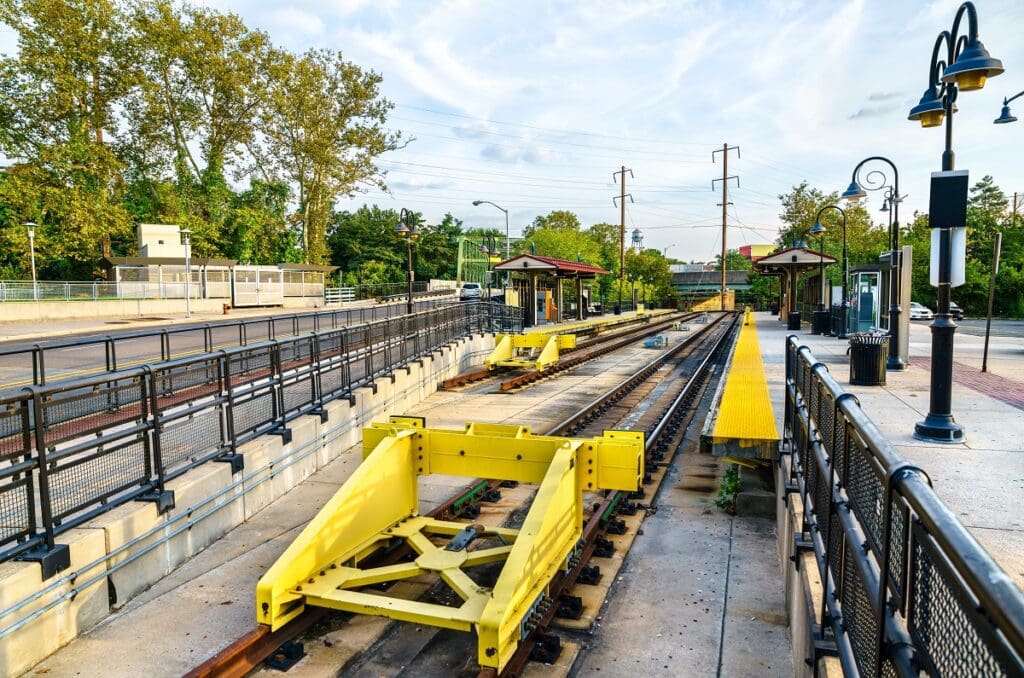
The Glassboro-Camden Light Rail, usually shortened to GCL, would run roughly 18 miles along an existing freight rail corridor, linking Gloucester County to Camden. Passenger trains haven’t run that stretch in decades, but the tracks never left. They cut through town after town, close to homes, schools, and small downtowns that were built when rail was part of everyday life.
People along the route know the list by now. Glassboro. Pitman. Sewell. Mantua Township. Deptford Township. Wenonah. Woodbury Heights. Woodbury. Westville. Brooklawn. Gloucester City. Camden.
If the line ever runs, riders could connect in Camden to the RiverLine toward Trenton, hop trains bound for Atlantic City, or reach Philadelphia via the Port Authority’s rail system from Lindenwold. Supporters say that kind of connectivity is exactly what South Jersey has been missing.
Opponents aren’t convinced.
The clearest sign of progress came Dec. 10, when NJ Transit’s board approved moving forward with acquiring a property at 525 Martin Luther King Boulevard in Camden. The agency can buy it or, if negotiations fall apart, use eminent domain. The site would be used for the rail line and as a staging area for the planned $250 million rebuild of the Walter Rand Transportation Center.
It’s the first of many. Project documents show the rail line would eventually require 216 properties across 14 municipalities. That number alone explains why emotions run high whenever this project comes up.
There’s also work moving forward in Mantua. The Delaware River Port Authority is preparing to award a contract to rebuild the Mantua Boulevard bridge over the Conrail freight line the light rail would use. Three construction companies are already in the mix.
The passenger tracks would sit about 25 feet away from the active freight line, similar to the setup used by the RiverLine between Camden and Trenton. Engineers are still sorting out details — platforms, station layouts, and how to manage crossings in towns that were never designed with modern light rail in mind.
Safety is one of the things planners point to most. The design includes four-quadrant gates that block traffic in both directions when a train approaches, plus gated sidewalks. The goal is simple: stop drivers and pedestrians from trying to sneak across tracks at the last second.
That doesn’t settle the bigger fight.
Mantua, Pitman, and Woodbury Heights passed resolutions opposing the project in recent years. Five of the 14 towns with proposed stations have either voted against it in non-binding referendums or formally rejected it through council action.
Opponents say they’re not done. Petition drives are expected in Gloucester City, Woodbury, and Westville. There’s also pressure building for state lawmakers to hold hearings on whether the cost to build and operate the system makes sense.
Some critics argue South Jersey would be better off expanding micro-transit ride-share programs, like the ones already running in Jersey City and Camden. They see rail as expensive and inflexible. Supporters counter that rail brings capacity and long-term development that shuttles simply don’t.
What’s changed this time is political backing.
NJ Transit CEO Kris Kolluri is moving the project forward with support from Gov. Phil Murphy’s administration and incoming Gov. Mikie Sherrill. That alignment hasn’t always been there, and it’s why opponents are worried the state is no longer waiting for unanimous local support.
This project didn’t appear overnight. Early studies started back in 2003. An environmental review wrapped up in 2020. Regional planners estimate Gloucester County’s population and job base could grow by nearly 30 percent by 2045, one of the highest projections in the state.
Supporters say the rail line could serve colleges, hospitals, and major employers while tightening South Jersey’s link to Philadelphia. Opponents say ridership still doesn’t justify a $2 billion price tag.
None of that has been settled.
But with bridge work advancing and the first property approved for acquisition, the Glassboro-Camden Light Rail has crossed into a phase where the arguments are no longer hypothetical. Something is finally happening, and that alone is enough to reignite a debate that never really went away.

The New Jersey Digest is a new jersey magazine that has chronicled daily life in the Garden State for over 10 years.