

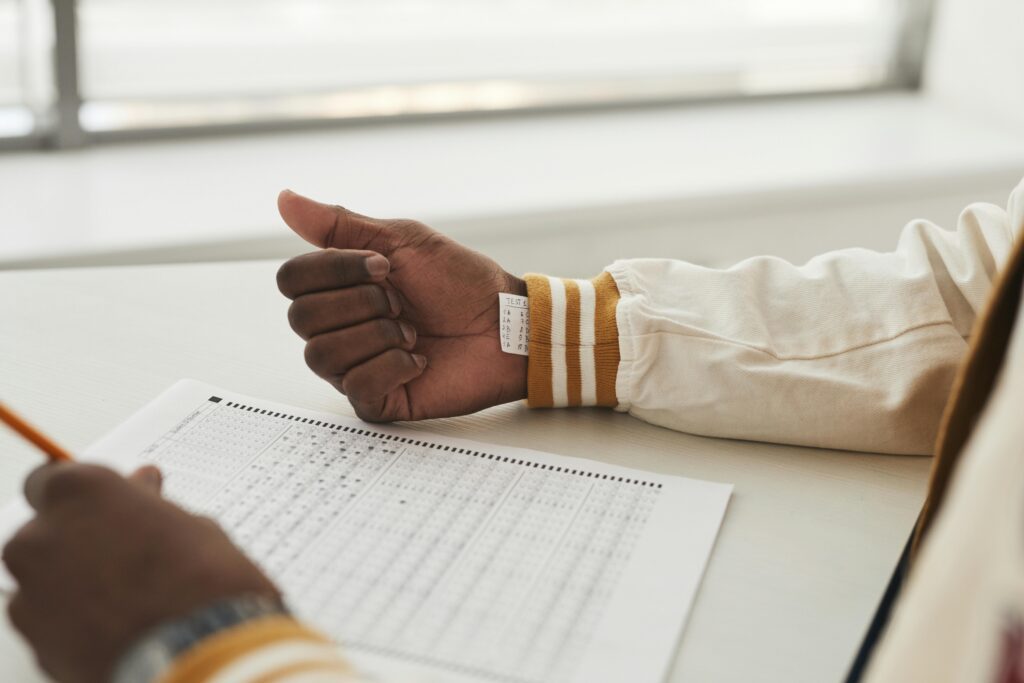

Former New Jersey Governor Phil Murphy implemented a change in state standardized testing just before Mikie Sherrill took over. These rules are now in effect for spring state exams in NJ schools.
Test Scores Dipped, Prompting Changes
These changes come after 52.2% of N.J. students tested at or above expectations in English Language Arts on the New Jersey Student Learning Assessments (NJSLA) from the 2023-2024 school year, state officials announced, while the number of students testing at or above expectations was 39.6% for math.
The main issue with these numbers is that they were below pre-pandemic levels, as the percentages had slightly dipped.
The 2024 statistics prompted the implementation of new ‘adaptive’ state testing, allowing the computer to select questions based on the student’s past responses.
According to NJ.com, the state’s largest teachers’ union and principals association had expressed concerns that the tests were “being rolled out too quickly and without enough input from teachers and administrators.” However, New Jersey’s Department of Education met regularly with education groups who “knew this would be coming,” a Murphy administration official said at the time.
The new exam—now called the New Jersey Student Learning Assessments-Adaptive—was field-tested in schools in the fall, state officials revealed in a statement.
“This field test is essential to evaluate the quality, clarity, and fairness of the assessment items before they are used in live administrations this coming spring,” the statement announced.
When it comes to the essay questions in the new state tests, however, AI will be the tool used to score most of the writing each student partakes in.
While adaptive statewide assessments are new in New Jersey schools this year, automated scoring (sometimes referred to as “AI”) has been used in New Jersey’s statewide assessments for the past eight years.
How the AI Scoring Works
Department of Education Spokesperson Michael Yaple explained how scoring works in an interview with NJ.com: “New Jersey has rigorous systems in place to continually monitor and identify potential issues. Not only do human scorers conduct random reviews, but any unusual or borderline essays are also flagged for review by trained human scorers.”
The AI will reportedly be trained using scores generated by human scorers from the fall 2025 practice tests.
Steve Beatty, president of the New Jersey Education Association and the state’s largest teachers union, stated that he wouldn’t want to see “some student fail on a computer-graded test only to find out later on that there was some sort of error.”
Yaple also pointed out that NJ state exams have been using computerized scoring for a while now. About 90% of the NJSLA essays from last year were predominantly scored by the automated scoring systems.
New Jersey’s high school exit exam for high school juniors will also feature a change, the New Jersey Graduation Proficiency Assessment–Adaptive. This test will specifically provide the educational tools and topics needed before graduating and moving on to the next steps.
The upgraded tests were developed by Cambium Assessment, a company that won a $58.7 million two-year contract with New Jersey.
According to the Cambium proposal, Measurement Incorporated—located in North Carolina—is responsible for training personnel to complete the “handscoring” when AI-generated essay and written-response scores are flagged for review.
In the proposal, Cambium said they assume only “25% of the overall responses will be routed for trained handscoring.”
Computer-Adaptive Testing Enters the Fold
This spring marks the first time statewide English and math assessments (NJGPA‑A and NJSLA‑A) will be adaptive. As students work through each question, the test adjusts on the fly. Strong answers may trigger slightly harder items, while a string of struggles can ease the difficulty.
The result: a sharper, more precise read on where each student actually stands.
Teachers and Parents Express Concerns
Unfortunately, AI scoring has caused concern in other states, including the Massachusetts Comprehensive Assessment System (MCAS).
Massachusetts’ testing contractor, Cognia, found around 1,400 essays that failed to receive the correct scores, according to a spokesperson with the Department of Elementary and Secondary Education.
The conflict was first found when a teacher at Reilly Elementary School in Lowell was reading through her third-grade students’ essays and noticed that the scores didn’t seem correct. The teacher proceeded to notify the principal.
“We were on alert that there could be a learning curve with AI,” said Wendy Crocker-Roberge, an assistant superintendent in the Lowell school district.
Crocker-Roberge decided to read about 1,000 of the essays and realized that the AI was reducing points for students without proper reasoning.
The assistant superintendent revealed that some essays lost a point when students failed to use quotation marks when referencing a passage from a reading excerpt.
“We could not understand why an individual score was scored a zero when it should have gotten six out of seven points,” Crocker-Roberge said. “There just wasn’t any rhyme or reason to that.”
A handful of parents “have no idea this is a thing,” said Julie Borst, executive director of community organizing for Save Our Schools New Jersey, referring to the AI scoring. Borst has previously expressed concerns that students might earn lower scores than expected because the AI will be searching for certain words and phrases.
When Do NJ Students Take the Tests?
New Jersey students will begin taking the new exams between April 27 and May 29. The exit exam for high school juniors will be from March 16 to April 1, according to a state Department of Education testing schedule.
With testing beginning soon, New Jersey parents and educators will soon see whether the AI scoring system delivers on its promise of fairness and accuracy—or repeats some of the errors seen in states like Massachusetts.

Julia is currently a senior at the Ramapo College of New Jersey studying Journalism while also minoring in Creative Writing and Digital Film. While growing up in Bergen County, she enjoyed exploring new restaurants and landmarks while also taking on different sports such as swimming. At college, she's one of the News Editors and writers at the Ramapo News, often crafting article revolving around entertainment, politics and campus events.