

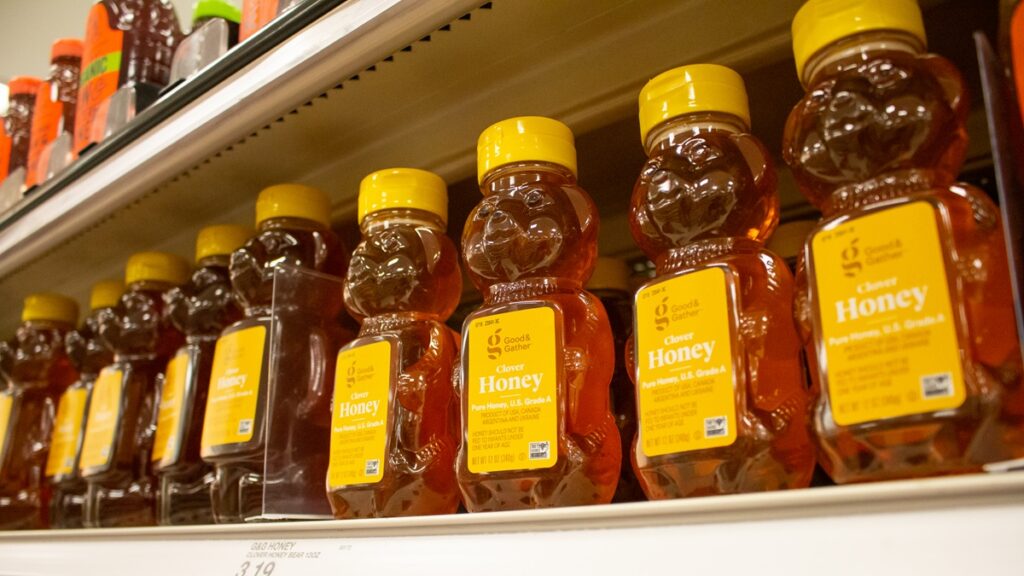

The billion-dollar adulteration problem hiding in the supermarket aisle—and why New Jersey, of all places, has the most honest answer.
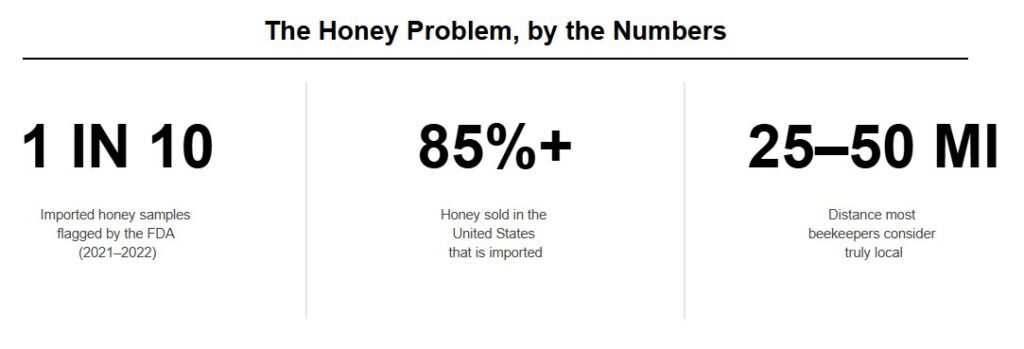
Some of the honey sold in U.S. grocery stores isn’t actually pure honey. An FDA test found that roughly 1 in 10 imported honey samples contained undeclared sweeteners such as corn syrup or rice syrup—ingredients never listed on the label.
Go to any supermarket in New Jersey—any of them, from the ShopRite off Route 9 to the Whole Foods in Marlton—and you will find, somewhere in the condiment aisle, a row of honey jars. Bears, hexagons, amber glass with gold lids. “Pure.” “Natural.” “100% Real.” The labels are categorical, the fonts are reassuring, and at least one of them is almost certainly not telling you the full truth.
The United States Food and Drug Administration spent the better part of 2021 and 2022 conducting targeted testing on imported honey products moving through American supply chains. What they found was not reassuring: roughly one in ten samples tested positive for undeclared sweeteners—corn syrup, rice syrup, cheap agricultural fillers introduced somewhere between the hive and the shipping container—none of it disclosed on the label. The FDA called it what it was: economically motivated adulteration.
In the language of food regulation, “economically motivated adulteration” is a formal category. In plain English, it means someone watered down the product to make more money and decided not to tell you about it. It is fraud. Not the kind that makes headlines, not the kind that lands anyone in handcuffs on the evening news, but fraud nonetheless, moving quietly through the supply chain and into the pantry of every household that grabbed the $6 bear without thinking too hard about it.
How Fake Honey Enters U.S. Grocery Stores
To understand how widespread this problem is, you have to understand where most commercial honey actually comes from. The United States imports a substantial majority of the honey sold in its grocery stores—primarily from Argentina, Brazil, India, Ukraine, and Vietnam, among others. Nothing inherently wrong with that. Bees are global. But the supply chain that moves honey from a hive in Southeast Asia to a shelf in Freehold, New Jersey, involves a remarkable number of hands, a number of which have financial incentives that run contrary to your interests as a consumer.
The most common form of adulteration is simple dilution: real honey—which is expensive to produce, weather-dependent, and labor-intensive—gets cut with high-fructose corn syrup or rice syrup before it’s bottled. The ratio can be subtle enough to be undetectable by taste alone. More sophisticated operations go further: they ultra-filter the honey to remove pollen, which is the most reliable molecular fingerprint for geographic origin. Honey without pollen is honey that can no longer be traced back to a country, a region, or a species of flower. From a regulatory standpoint, it is nearly anonymous.
This creates obvious opportunities for falsifying country-of-origin paperwork, which is its own downstream problem. Honey from countries subject to import duties or heightened scrutiny has a long documented history of being relabeled as it passes through intermediary countries. The FDA acknowledges it collaborates with international counterparts specifically to chase these paper trails. That collaboration is ongoing. So, presumably, is the fraud.
The FDA is in on it. Mostly.
To the FDA’s credit, this is not a problem the agency is ignoring. Its import sampling program actively tests honey coming through U.S. ports. Violative samples—those testing positive for adulteration—are subject to recall and import refusal. The agency has indicated it will continue its testing protocol under a risk-based import entry screening program, and where appropriate, it may refer cases for criminal investigation.
That last phrase deserves a beat of acknowledgment. Criminal investigation. For honey.
But here is the structural tension that no press release fully resolves: the FDA is a large agency with a vast mandate, limited inspectors, and a global food supply that moves at container-ship speed. Import sampling is, by its nature, a sample. It catches what it catches. The honey that doesn’t get flagged keeps moving. The bear-shaped bottles keep getting stocked. And the consumer standing in the ShopRite aisle has no real mechanism, short of sending a jar to a food science lab, to know what they’re actually buying.
“Someone watered down the product to make more money and decided not to tell you about it. It is fraud—not the kind that makes headlines, but fraud nonetheless, moving quietly through the supply chain.”
How It Affects New Jersey
Here is where things get interesting, and where this particular story takes a turn that people who have never driven through the Pine Barrens in July might find genuinely surprising: New Jersey is, without exaggeration, one of the better places in the northeastern United States to buy real honey.
Go ahead and sit with that for a second.
We’re the Garden State for a reason. The state that gave the world the Turnpike, the Parkway, and a decades-long reputation as the punch line of an airport joke also happens to have a thriving local beekeeping culture, a robust “Jersey Fresh” agricultural certification program, and a geography that produces some legitimately distinctive honey varietals. Blueberry blossom honey, harvested from the cultivated fields of the Pine Barrens and the berry farms of Burlington County. Cranberry blossom honey from Ocean and Burlington Counties. Wildflower honey from the Highlands in the north, where the ridgelines catch weather from three directions and the meadows run thick through summer. The state’s agricultural diversity, often overlooked in favor of its industrial reputation, translates directly into what ends up in the comb.
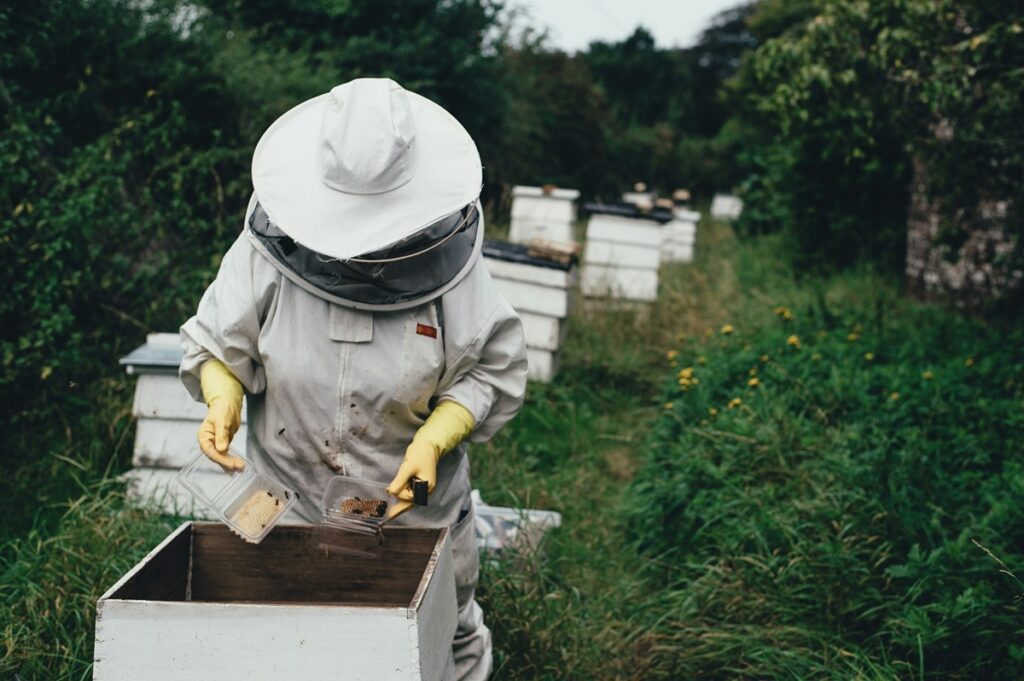
Small and mid-sized apiaries have been operating across all three regions—North, Central, and South—for generations, and they are producing honey the old way: raw, unheated, unfiltered. Pollen intact. Flavor intact. Origin traceable to a specific county, sometimes a specific farm. When a jar says “Hillsborough Harvest,” you can, in principle, drive to Hillsborough and look at the hives. Try doing that with a bear bottle from the supermarket.
What “Raw” and “Local” Honey Actually Means
The labeling on commercial honey has a way of borrowing the vocabulary of quality without delivering the substance. “Pure” means nothing enforceable in a regulatory sense. “Natural” is similarly unmoored. Even “raw” can be applied loosely. So it’s worth being precise about what these terms mean when they’re used honestly, because the distinction has real consequences.
Raw honey, properly defined, is honey that has not been heated above the temperature of a hive—roughly 95 degrees Fahrenheit—and has not been fine-filtered to remove pollen. It will often crystallize over time. It may look cloudy. It tastes more complex than the ultra-processed stuff because it is more complex: enzymes, trace proteins, pollen, propolis residue, all present in proportions that reflect what the bees actually collected. Commercial honey, by contrast, is routinely heated to well above 150 degrees during processing to prevent crystallization and extend shelf life. The process makes it look more uniform and flow more smoothly into a bear-shaped bottle. It also strips out most of what makes honey interesting.
“Local,” meanwhile, is not merely a provenance claim—it has a functional implication for anyone buying honey for its purported allergy benefits (though many of those benefits may still be unproven). The theory, which has a reasonable physiological basis even if the clinical evidence remains mixed, is that regular consumption of locally produced honey may help desensitize you to the specific pollens in your immediate environment. That only works if the honey actually contains those pollens, which means it needs to come from hives close enough to your home to share your local flora. The working guidance from beekeepers and allergy-focused consumers is within 25 to 50 miles. A jar labeled “Product of Multiple Countries”—which you will find on a surprising number of mainstream brands—is not doing that work for you.
Where to Actually Buy Honey in New Jersey
The New Jersey Beekeepers Association maintains a directory of local producers organized by county, which is the most reliable place to start if you want something hyperlocal to your town. But the state’s landscape breaks naturally into three honey regions, each with distinct producers and distinct flavor profiles worth knowing. If you want to be an informed buyer, HarBee Beekeeping in Dumont, E & M Gold Beekeepers in Tinton Falls, and Top of the Mountain Honey Bee Farm in Wantage are just a few of the dozens worth mentioning in the NJBA directory.
How to Tell if Your Honey Is Real
- Check the country of origin
- Avoid jars labeled “ultra-filtered”
- Real honey often crystallizes over time
- Buy honey produced within 25-50 miles
None of this is an argument for panic. The honey you bought last month probably did not poison you. It is not laced with anything dangerous; adulterated honey is, at worst, overpriced corn syrup wearing a disguise. But there is something worth taking seriously in the fact that a product as elemental as honey—something humans have been collecting from hives for thousands of years—now requires a federal testing program to ensure it is what it says it is.
And there is something worth noticing in the counter-argument that exists, quietly, right here. New Jersey has a beekeeping culture that is older than the state’s reputation for congestion, a geography that produces genuinely distinctive flavors, and a network of small producers who are, by definition, not cutting corners because their names are on the jar and their neighbors know where to find them.
The next time you reach for the $6 bear-shaped bottle, remember that honey is one of the most adulterated foods in the global supply chain.
In New Jersey, though, you have another option—jars that can be traced back to actual hives, actual farms, and beekeepers whose names are on the label. And the honey, at minimum, will actually be honey.
FDA testing data: U.S. Food & Drug Administration import sampling program findings, released December 2022. For a county-level producer directory, consult the NJBA Local Honey Directory at njbeekeepers.org.

Michael is the Editor-in-Chief of New Jersey Digest and Creative Director at X Factor Media. A Bergen County native, he discovered his passion for storytelling while studying at Montclair State University. In addition to his work in journalism and media, Michael is an avid fiction writer. Outside the office, he enjoys kayaking, a bold glass of Nebbiolo, and the fine art of over-editing.