

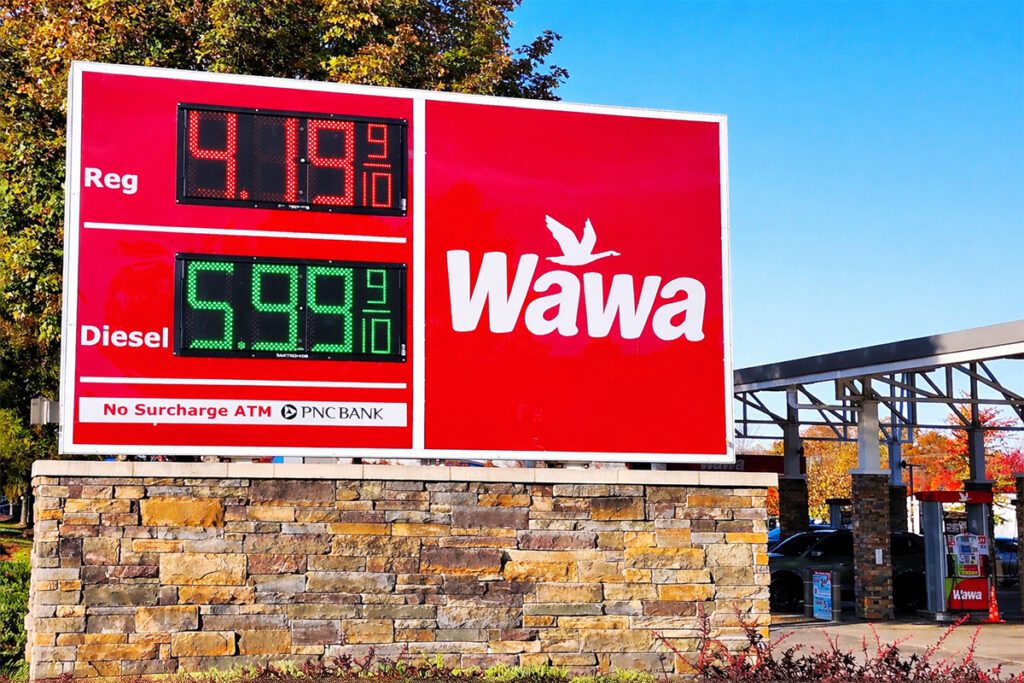

New Jersey drivers are seeing one of the fastest spikes in gas prices in years. Just 30 days ago, a gallon averaged $2.91. As of Tuesday, it’s $3.92, nearly a full dollar increase in a single month (and to over $4 in some New Jersey counties).
The county breakdown tells the story in sharp relief. Cape May sits at the high end of the state, near $3.96. Somerset, Ocean, and Monmouth counties are all above $3.89. Even Bergen County, historically one of the more affordable places to fill up in North Jersey, is running above $3.78. Folks in Flemington report seeing $4.19. The cheapest gas in the state right now is in Salem County, followed by Passaic and Hudson; but even the deals are gone by the old definition of the word. If you’re filling a 15-gallon tank, you’re paying roughly $15 more than you were 30 days ago, regardless of where you live in New Jersey.
The cause isn’t a domestic refinery issue or a pricing dispute. It traces directly to a stretch of water called the Strait of Hormuz—a 21-mile-wide passage between Iran and Oman through which roughly 20 percent of the world’s oil supply travels every day. Since the U.S.-Israel military operation against Iran launched at the end of February, Iran has effectively shut that passage down. Tankers have been struck. Insurance premiums have spiked to levels that make transit economically irrational. Major shipping companies have suspended routes. The oil that would normally flow through that chokepoint is sitting stranded, and global markets are reacting accordingly.
Brent crude prices surged nearly 60 percent in March alone, crossing $112 a barrel this week before climbing further after an Iranian drone struck a fully loaded Kuwaiti oil tanker at Dubai Port on Tuesday—the vessel was carrying 2 million barrels of oil. Goldman Sachs has raised its U.S. recession probability to 25 percent. The Federal Reserve Bank has modeled that a full-quarter closure of the strait would raise West Texas Intermediate crude to $98 per barrel and shave nearly 3 percentage points off global GDP growth. Analysts at Oxford Economics say that if prices average $140 a barrel for two sustained months, the U.S. economy effectively stalls.
For New Jersey drivers, this is already translating to something more immediate than macroeconomic modeling. The average price per gallon has jumped 35 percent since the end of February. GasBuddy data shows the cheapest gas in the state right now is at Costco in Union at $3.33—a bargain by the current moment’s standards, and still a dollar more than prices were nationally just weeks ago. The last time New Jersey saw numbers like these was the summer of 2022, when the Russia-Ukraine war drove prices past $5 in some parts of the state in June. This escalation has been faster. The current jump from under $3 to nearly $4 happened in roughly four weeks.
There’s a compounding problem on the horizon. Summer blends of gasoline—the reformulated fuel that refineries are required to produce for warmer months—are coming, and that transition typically adds 15 to 25 cents per gallon on its own.
The broader impact extends past the pump. Diesel is up close to a dollar a gallon over a month ago—and diesel is the fuel that moves freight, agriculture, and commercial logistics across New Jersey’s dense transportation network. When diesel goes up, the cost of nearly everything that gets delivered goes up with it. Fertilizer prices have surged more than 50 percent since the start of the conflict, threatening food cost increases that analysts say could carry into 2027. Plastics, packaging, automotive parts, and pharmaceutical inputs all flow through supply chains tied to Gulf region production. Every day the strait stays closed, that pressure deepens.
President Trump extended his deadline to Iran to reopen the waterway to April 6. Iran has not softened its position. The Islamic Revolutionary Guard Corps has stated publicly that it will not allow oil through, and some officials have warned crude could reach $200 a barrel if the standoff continues. That is the outer edge of the scenario range—but the fact that parties on both sides of the conflict are citing itreflects how seriously the market is taking the threat.
If disruptions continue into the summer, prices won’t stop at $4—and could climb significantly higher just as peak driving season begins.

The New Jersey Digest is a new jersey magazine that has chronicled daily life in the Garden State for over 10 years.