

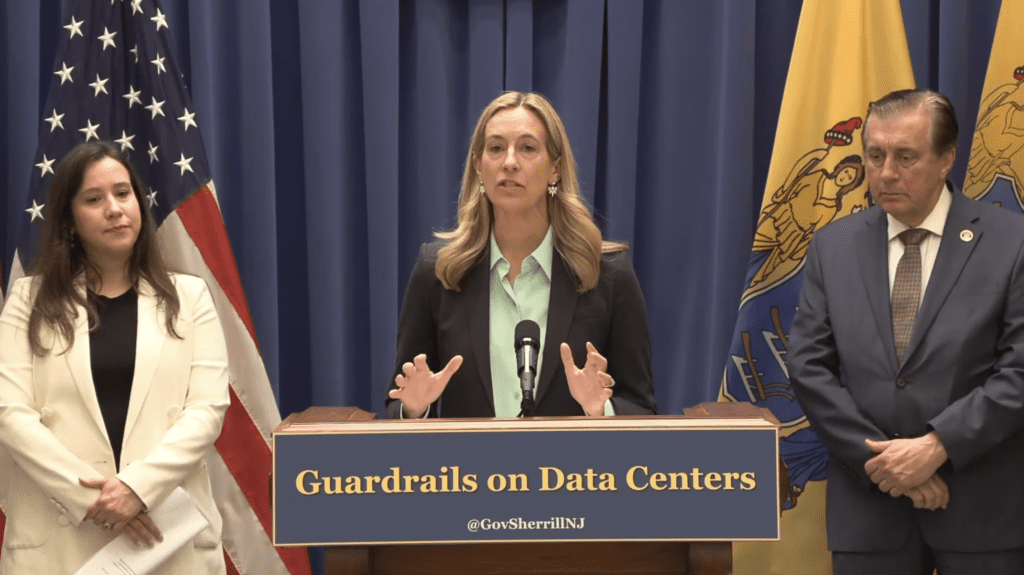

Governor Mikie Sherrill unveiled what she called the first comprehensive statewide data center strategy in the country Wednesday, announcing a four-part plan to rein in the unchecked growth of AI data centers in New Jersey and protect residents from rising energy costs. However, the governor stopped short of announcing a moratorium on data center construction, as several groups have urged her to do.
“Data centers are among the biggest drivers of energy costs, which I am working tirelessly to bring down,” Sherrill said. “While many states are approaching this issue piecemeal, this is the first comprehensive plan to tackle it holistically. At the same time, New Jersey will take a thoughtful approach to harnessing investment, lowering costs for ratepayers, and leading on AI innovation.”
New Jersey is already home to more than 80 data center facilities, and the state has faced growing pressure from residents, municipalities, and environmental groups demanding guardrails on the industry’s expansion. With legislation expected to move through the statehouse immediately, Sherrill’s plan represents a direct response to that pressure—and a bid for national leadership.
“Today I’m stepping up to establish clear guardrails—the first comprehensive strategy across the country,” Sherrill said. “It feels out of control, like the Wild West. We’ve got your back. I have a plan.”
The Four-Part Plan
Sherrill outlined four pillars of her strategy:
Pay their fair share. Data centers would be required to bring new clean energy online and contribute to the grid infrastructure needed to support their growth—shifting costs away from residents and ratepayers rather than to them.
Operate transparently. Data centers would be required to report energy and water use every six months, giving the public greater visibility into the impact of large-scale facilities.
Invest in communities. The plan calls for strong statewide standards for Community Benefits Agreements, with state resources provided to ensure municipalities can negotiate from positions of strength. Data centers would be expected to address impacts like light, noise, and pollution while making meaningful local investments. “For a long time in America it was understood that if a business wants to thrive in a community, it has to give back to that community,” Sherrill said.
Create good jobs. Data centers would be required to leverage local trades and pay prevailing wages. “I’m on a mission to drive down costs in the state,” Sherrill said, noting New Jersey has more scientists and engineers per square mile than any other state.
Broad Coalition Behind the Plan
Senator Burzichelli, who spoke after Sherrill, acknowledged the state is playing catch-up but said the legislation would provide a backbone for municipalities navigating data center proposals. “This is not easy. It’s going to occur step by step. What you’re hearing today is an important step. We’re going to figure it out,” he said, adding that New Jersey needs to work with other states given the shared impact on the regional grid. He took a subtle shot at PJM, the regional grid operator, saying “they don’t see us as a partner.”
Senator David Bailey called the rapid growth of data centers unprecedented and said tech companies—not constituents—should be footing the bill for their energy demands.
The leader of the International Brotherhood of Electrical Workers in New Jersey expressed support for the plan, calling for strong statewide standards to address noise and infrastructure impacts alongside strong labor standards for good-paying union jobs. “New Jersey has an opportunity to become a leader,” he said.
Mount Arlington Mayor Michael Stanzilis said data center development is necessary but that mayors have a right to question it. He noted that advanced cooling systems and closed-loop technology can address water use concerns, but only with clear standards in place.
Returning to the podium for questions, Sherrill emphasized that transparency and community input are essential to moving forward. Without them, New Jersey risks missing out on innovation entirely.
“I’m not the 10-year-plan governor. I’m the do-it-now governor,” Sherrill said.
She closed with a broader vision for the state’s future: “We are making sure—as we see this new economic future—that we’re not being left behind. That our kids will not be left behind. That we will have the best jobs right here in New Jersey. At the same time, we are the most densely populated state. We need to make sure that as we are building this future, we are doing so in a way that protects our communities. This plan is how we move forward and how we solve for both.”
Wednesday’s announcement builds on a broader energy agenda Sherrill has pursued since taking office—including executive orders to freeze rate hikes and expand power generation, approval of six large-scale solar and battery storage projects, a historic expansion of community solar to 3,000 MW, and legislation to accelerate battery storage deployment and lift the 50-year moratorium on new nuclear energy.

The New Jersey Digest is a new jersey magazine that has chronicled daily life in the Garden State for over 10 years.