

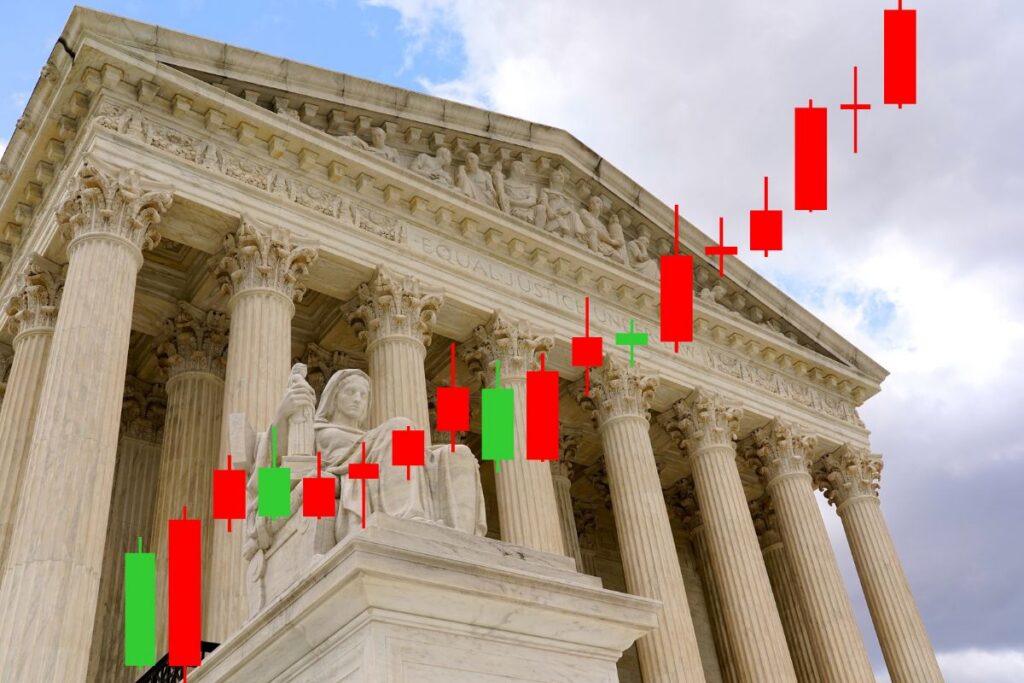

Prediction markets are the hottest new thing in the world of betting. But unlike traditional sportsbooks, platforms like Kalshi and Polymarket let users wager money on real-world outcomes that extend way beyond sports. Election outcomes, Supreme Court decisions, foreign policy decisions, industry layoffs—the list goes on and on.
Despite the broad range of bets available, sports bets account for a vast majority of trading volume each week—over 80%.
Still, the platforms have skeptics worried about the implications of monetizing anything and everything. In fact, in Kalshi’s own words, the platform is an “open, nationwide financial exchange” and not a sportsbook. And it’s this exact framing that allows them to dodge state gambling laws by self-certifying on a federally regulated exchange.
NJ Brings the Fight to SCOTUS
New Jersey is now asking the Supreme Court to intervene, making them the first state to do so. On Wednesday, September 2, Attorney General Jennifer Davenport filed a petition with the court to revisit a question: can prediction markets offer sports wagers without following state sports-gambling laws?
In April, the Third Circuit ruled all event contracts are “swaps,” meaning platforms like Kalshi are under the regulatory authority of the federal CFTC, and not the states. But in August, the Ninth Circuit ruled the exact opposite—that sports-related event contracts are not CFTC-regulated.
“We’re calling on the Supreme Court to resolve this issue and recognize that Congress did not silently make the sports-betting industry immune from state law,” said Davenport in a statement. The Attorney General argues that state gambling laws aren’t just to constrict the companies, but to protect against compulsive gambling, insider trading, and gambling by minors. “The Third Circuit’s profoundly important decision is also profoundly wrong.”
Kalshi’s fired back. “Kalshi is an open, nationwide financial exchange. It cannot be regulated by 50 different regulators,” said spokesperson Dani Lever, according to NPR. “Nothing in New Jersey’s filing today changes our view.”
New Jersey isn’t alone in this fight—44 state Attorneys General agree with the premise. Traditional sportsbooks like FanDuel and DraftKings pay billions in state taxes, while prediction markets like Kalshi and Polymarket avoid the same regulations. Shares for DraftKings and Flutter Entertainment (FanDuel) rose 5% after NJ’s filing, according to CNBC.
The Trump Admin, Polymarket & Insider Trading
The Trump Administration reportedly backs prediction markets, complicating states’ efforts to regulate them. Donald Trump Jr.’s venture capital firm, 1789 Capital, has pumped $500 million of investment into Polymarket. Trump Jr. sits on the advisory board for the platform.
This unique relationship to the industry has also prompted accusations of insider trading. In January, an anonymous bet for $32,000 was placed on Polymarket that predicted Venezuelan President Nicolás Maduro would be out of office by the end of the month. Shortly after the bet was placed, the Trump admin announced that U.S. soldiers conducted an operation capturing him. Good enough for a $436,000 payout. It was later discovered that U.S. Army Special Forces Master Sgt. Gannon Ken Van Dyke was behind the suspicious trade.
In another instance, former White House teleprompter operator Gabriel Perez made $107,500 on prediction markets by betting on words and phrases that President Trump would say in speeches. Of course, his access to the speeches before airing makes it a clear case of insider trading. He later settled, turning over the profits, and paying a $65,000 fine.
On April 7, more than 50 newly formed Polymarket accounts bet on a U.S.-Iran ceasefire, despite Trump’s dialogue in the days prior suggesting escalation. That same day, Trump announced a pause in hostilities, landing hundreds of thousands in profits for the well-timed bets. One account opened just 12 minutes before Trump’s announcement earned a profit of $48,500.
What’s Next
SCOTUS will decide later this fall whether to hear New Jersey’s case. If accepted, arguments would ensue shortly after, and a decision would be expected by next summer. Prediction Markets are still a relatively new thing, and as trade volume increases, states are left wondering why we aren’t regulating them the same as traditional sportsbooks.
That’s the million dollar question—or, billion dollar question. One that New Jersey, and 44 Attorneys General across the country, want answered.

Peter Candia is the Food + Drink Editor at New Jersey Digest. A graduate of The Culinary Institute of America, Peter found a passion for writing midway through school and never looked back. He is a former line cook, server and bartender at top-rated restaurants in the tri-state area. In addition to food, Peter enjoys politics, music, sports and anything New Jersey.
