

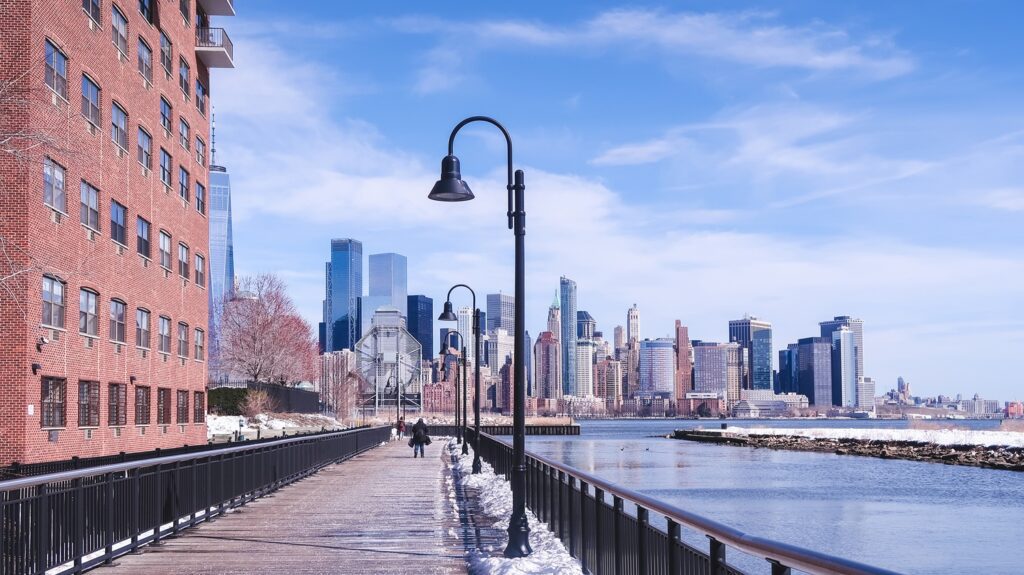

For years, Jersey City played a familiar role in the New York real estate ecosystem. It was the place people landed when Manhattan rents became unbearable—a temporary solution, a compromise, a few PATH stops away from where they actually wanted to be.
That framing no longer holds.
According to local realtors and market data, Jersey City has shifted from a stopgap into something more permanent. Buyers and renters aren’t just passing through on their way back to New York. Increasingly, they’re staying.
“Jersey City is definitely an endgame for most residents,” said Leilani Chin, Broker-Associate at Corcoran Sawyer Smith. “Once you get used to the amount of space and ‘little luxuries’ like in-unit washer/dryer, dishwasher, outdoor space and sometimes parking, it’s hard to give that up to live in NYC and pay even more.”
Space remains the clearest divider. At comparable price points, Jersey City apartments often offer 30 to 50 percent more square footage than similar units in Manhattan. That difference shows up in real ways: dining areas that aren’t multipurpose, home offices that don’t double as bedrooms, closets that actually store things, and appliances Manhattan renters still treat as upgrades.
For families, the gap widens further. Three-bedroom apartments that routinely cost $7,000 to $10,000 a month in Manhattan often land between $3,500 and $5,000 in Jersey City. The savings are substantial, but so is the tradeoff in livability.
Remote and hybrid work has only accelerated that calculation. With many professionals commuting into Manhattan two or three days a week instead of five, the PATH ride feels less like a burden and more like a manageable routine. Being close enough for work, but far enough to gain space, has become the sweet spot.
“Most people work in NYC, so they still get their fix of being within the hustle and bustle,” Chin said. “But then get to come back to Jersey City to their incredible home.”
That doesn’t mean Jersey City is cheap. Far from it.
Rents have climbed sharply over the past several years, narrowing what used to be a clear affordability advantage over Manhattan and even parts of Brooklyn. Average rents now routinely fall between the low $3,000s and high $3,000s, depending on neighborhood and unit size, according to data from RentCafe. In some cases, Jersey City and Hoboken rents now rival—or exceed—parts of Brooklyn.
That shift has complicated the city’s pitch. For some renters, crossing state lines no longer feels like a financial win, especially when Brooklyn or Queens offer similar prices with easier social integration and no change in state tax obligations.
At the same time, demand remains strong. Vacancy rates are low. Inventory has grown rapidly, but absorption has kept pace. Jersey City continues to add residents each year, fueled by international migration and steady interest from higher earners.
The result is a market under pressure from both sides: rising costs and rising expectations.
Families, in particular, are staying longer than they once did—not always by choice.
“Families tend to stay longer than they did 5 to 10 years ago, mostly because it is very hard to find their next home,” Chin said. “Prices in the commuter suburban towns are astronomical and have tons of competition, making it extremely hard to get an offer accepted.”
There’s also the interest-rate reality. Many homeowners locked in historically low mortgage rates and now face the prospect of giving them up.
“On top of that, they are most likely giving up their low interest rate for a much higher interest rate,” Chin said. “It’s another variable to consider—constantly asking themselves, is it worth it to leave Jersey City?”
That hesitation keeps people rooted. Some expand within the city rather than leaving it altogether.
“I have clients in every neighborhood throughout Jersey City and it feels like once you plant roots in one area, you tend to stay there when you upgrade,” Chin said. “Downtown Jersey City residents often branch into other neighborhoods, but out of necessity since Downtown has become unaffordable for most.”
Neighborhood identity plays a growing role. The Heights, once framed as a future bet, has already arrived.
“A lot of people refer to The Heights as ‘up-and-coming,’ but I can assure you it’s here,” Chin said. “There are people buying condos for over $1.5 million.”
Attention is now shifting south and west.
“If you are looking for an up-and-coming area, I would focus in the Bergen-Lafayette neighborhood,” she added, “although there have been some shockingly high sales there in the past couple of years.”
Jersey City’s appeal isn’t limited to housing. Waterfront development has transformed areas like Paulus Hook, Newport, and Downtown into amenity-heavy neighborhoods that rival luxury buildings across the Hudson. Rooftop pools, coworking lounges, and skyline views are no longer differentiators; they’re expectations.
Liberty State Park remains a standout. Hundreds of acres of green space, bike paths, and waterfront access offer something Manhattan residents rarely enjoy: room to breathe.

The city’s food and nightlife scene has matured alongside its housing stock. Newark Avenue’s pedestrian plaza anchors a dining ecosystem that reflects Jersey City’s diversity, while venues like White Eagle Hall and the Loew’s Jersey Theatre bring touring acts and cultural programming into the city itself.
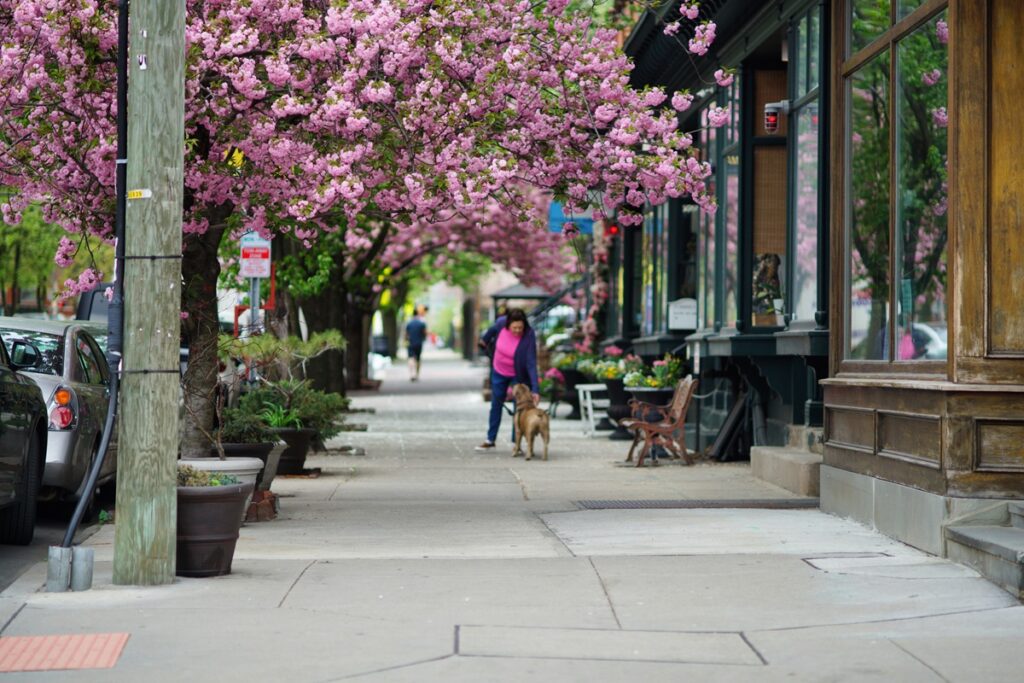
For pet owners, Jersey City offers something New York often can’t: tolerance. Larger units, outdoor space, and dog-friendly parks make daily life easier. It’s not an afterthought—it’s a feature.
All of this adds up to something more durable than a temporary solution.
“I see Jersey City as a place where more people can build a realistic future,” Chin said. “More affordable housing surrounded by incredible small businesses, some of the best restaurants in NJ, and easy commuting to work, while also being one of the most diverse places in the country. A great quality of life is more sustainable in Jersey City.”

That doesn’t mean everyone stays forever.
“Families are finding creative ways to make their existing spaces work,” Chin said. “But I do find that after the second child is toddler age, they end up calling me to sell.”
Still, the larger shift is clear. Jersey City is no longer defined by what it isn’t. It’s not the cheaper Manhattan. It’s not the temporary stop.
It’s a city people now choose—and increasingly, commit to.

Michael is the Editor-in-Chief of New Jersey Digest and Creative Director at X Factor Media. A Bergen County native, he discovered his passion for storytelling while studying at Montclair State University. In addition to his work in journalism and media, Michael is an avid fiction writer. Outside the office, he enjoys kayaking, a bold glass of Nebbiolo, and the fine art of over-editing.