


On a clear summer night, Liberty State Park feels like the center of the world. The Statue of Liberty glows across the harbor. Manhattan flickers behind it. Ferries hum past in the dark water.
It was supposed to be one of the defining images of the 2026 World Cup: tens of thousands of fans draped in jerseys, flags rippling in the wind, the skyline framing the biggest tournament on Earth.
Now, that scene won’t happen.
With the World Cup just four months away, the New York/New Jersey host committee has scrapped its planned fan festival at Liberty State Park in Jersey City—an event once billed as a gathering place for supporters during all 104 matches of the tournament. Tickets had already gone on sale late last year. The announcement of the festival itself came with fanfare earlier in 2025.
Instead, state leaders say the focus is shifting—away from a single waterfront spectacle and toward something more diffuse, and arguably more ambitious: a $5 million investment into community-based events across New Jersey.
A Different Vision of “Home Field”
New Jersey Governor Mike Sherrill framed the decision not as a retreat, but as a recalibration.
Calling the state the “beating heart” of the 2026 World Cup, Sherrill said the goal is to ensure that residents from Cape May to Paterson feel ownership of the moment—not just those who can travel to a marquee park along the Hudson.
The new initiative promises funding for local fan zones, neighborhood watch parties, street fairs, and community festivals. The emphasis is on small businesses, cultural organizations, and nonprofit groups—the storefront bakeries, youth soccer leagues, and immigrant associations that form the social fabric of the state.
In other words: fewer mega-screens against the Manhattan skyline, more block parties on Main Street.
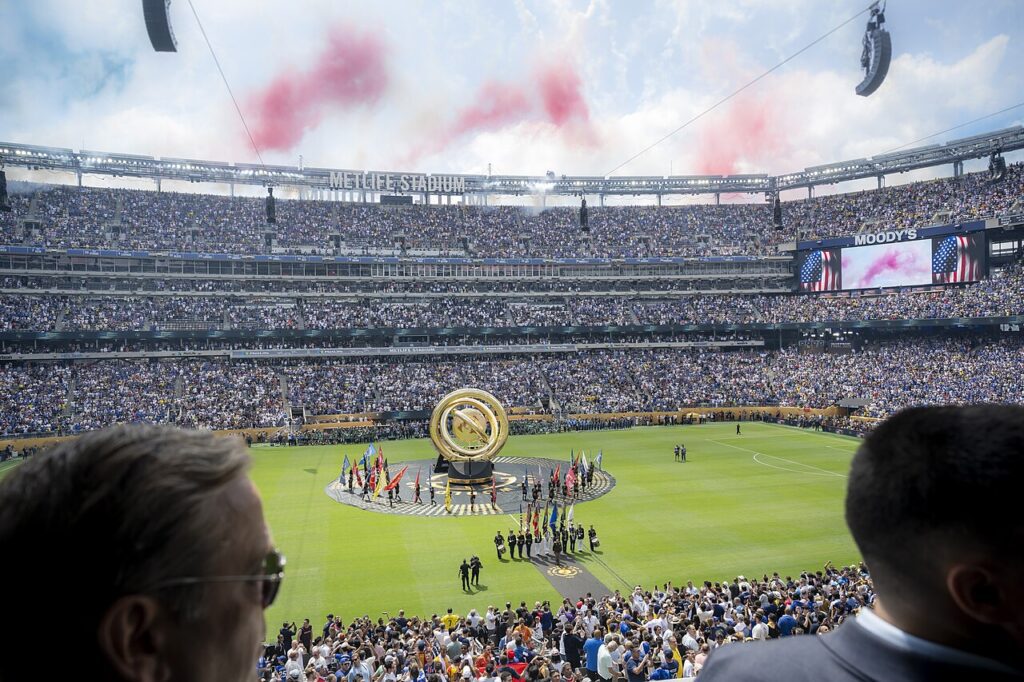
For a state that will host the World Cup final at MetLife Stadium on July 19, the symbolism matters. The tournament may be global, but the politics—and the pride—are local.
The Stakes Are Enormous
The 2026 World Cup is expected to be the largest in history, expanded to 48 teams and 104 matches across North America. For New Jersey, it represents both an economic opportunity and a logistical stress test.
Liberty State Park, perched beside Ellis Island and the Statue of Liberty, would have delivered postcard-perfect imagery to billions watching worldwide. But events of that scale also require layers of security, infrastructure, transportation coordination, and cost management—especially in a region already bracing for an influx of international visitors.
By dispersing celebrations across the state, officials appear to be betting on resilience over spectacle.
Evan Weiss, CEO of the New Jersey Economic Development Authority, described the strategy as an effort to channel the tournament’s energy directly into neighborhoods. The aim, he said, is not simply to host matches—but to convert global attention into tangible economic momentum for small enterprises and community institutions.
It’s a subtle but significant pivot: from centralized celebration to distributed impact.
The Party Isn’t Canceled: It’s Moving
For fans worried that the tri-state area is dialing back its World Cup ambitions, there are still headline events on the calendar.
A fan festival remains scheduled at the Billie Jean King National Tennis Center in Queens from June 17 through June 28. A separate fan village is set to take over Rockefeller Center in Manhattan from July 4 to July 19—culminating the same day the World Cup final kicks off at MetLife Stadium in East Rutherford.
New York City’s landmarks will still provide the global backdrop.
But New Jersey’s message is clear: the story of 2026 won’t be confined to a single park overlooking the harbor.
A Risk and an Opportunity
There’s undeniable romance in the idea of a World Cup crowd gathering beneath Lady Liberty. Canceling that vision invites criticism, especially so close to kickoff.
Yet there’s also a compelling argument embedded in the pivot. Soccer’s power has always lived as much in neighborhood parks and immigrant enclaves as in massive arenas. In New Jersey—one of the most diverse states in the country—the World Cup will resonate in Portuguese bakeries in Newark’s Ironbound, Colombian restaurants in Elizabeth, youth leagues in Morris County, and Caribbean street fairs in Jersey City.
A single waterfront festival would have been cinematic.
A thousand local celebrations might be transformational.
Four months out from the biggest sporting event on the planet, New Jersey has made a choice: less skyline, more sidewalk.
And when the final whistle blows at MetLife Stadium this July, the real measure of success may not be how many fans stood beside the Statue of Liberty—but how many communities felt like they were part of history.

The New Jersey Digest is a new jersey magazine that has chronicled daily life in the Garden State for over 10 years.