

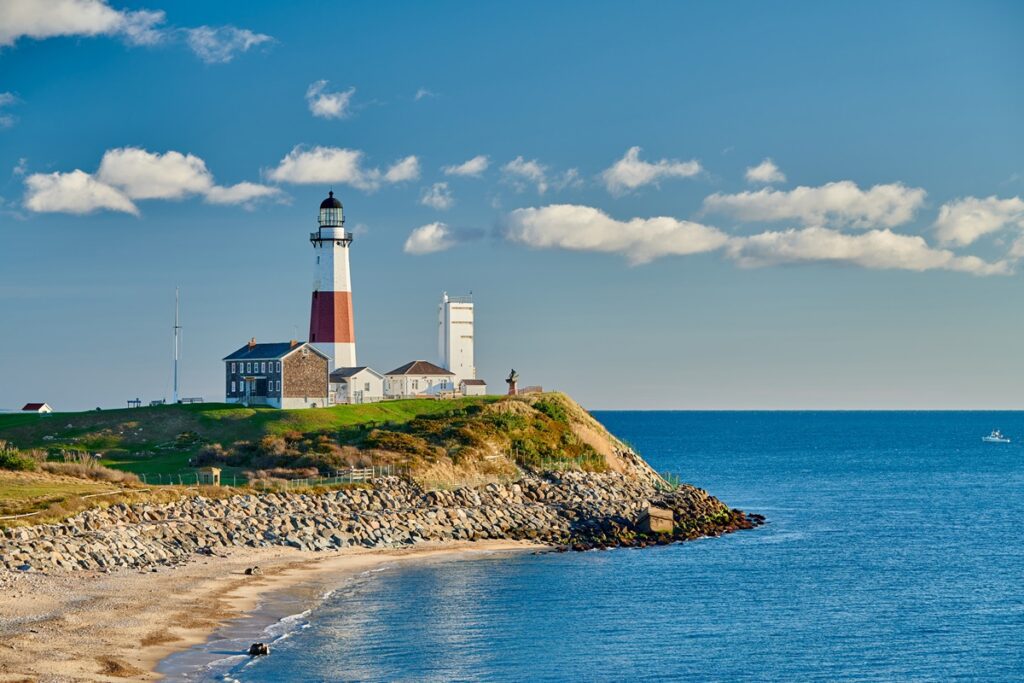

Montauk, the historic seaside town at the eastern tip of Long Island, is just a $30 train ride from New York City—offering beaches, a lighthouse, and centuries of history at the edge of the Atlantic.
On a clear Saturday morning, before the city has fully decided to wake up, Penn Station hums with a particular kind of anticipation. Not the commuter grind—that’s a different energy entirely, the Tuesday 7:42 AM, the thousand-yard stare into a cold coffee. This is lighter. People dragging canvas bags that clink faintly. Someone with a surfboard. A woman in a wide-brim hat reading a paperback. These are the Montauk people, the ones who figured out that the most consequential train ride in the metro area doesn’t go west. It goes east—all the way east, to the absolute last stop, to a place that calls itself, without any irony, The End.
For anyone reading this from New Jersey, that Penn Station is already your Penn Station. Same building, same escalators, same overpriced sandwich counter you always pass without stopping. You just have to buy a Long Island Rail Road ticket instead of a NJ Transit one, board the Montauk Branch, and give it about three hours. Off-peak, you’re looking at around $30 to $33 each way. What arrives at the other end is something no one who grew up on the Jersey Shore will need explained to them—a beach town with serious bones, serious history, and a stubbornness about staying itself that deserves some respect.
Getting There: The Logistics, Plainly Stated
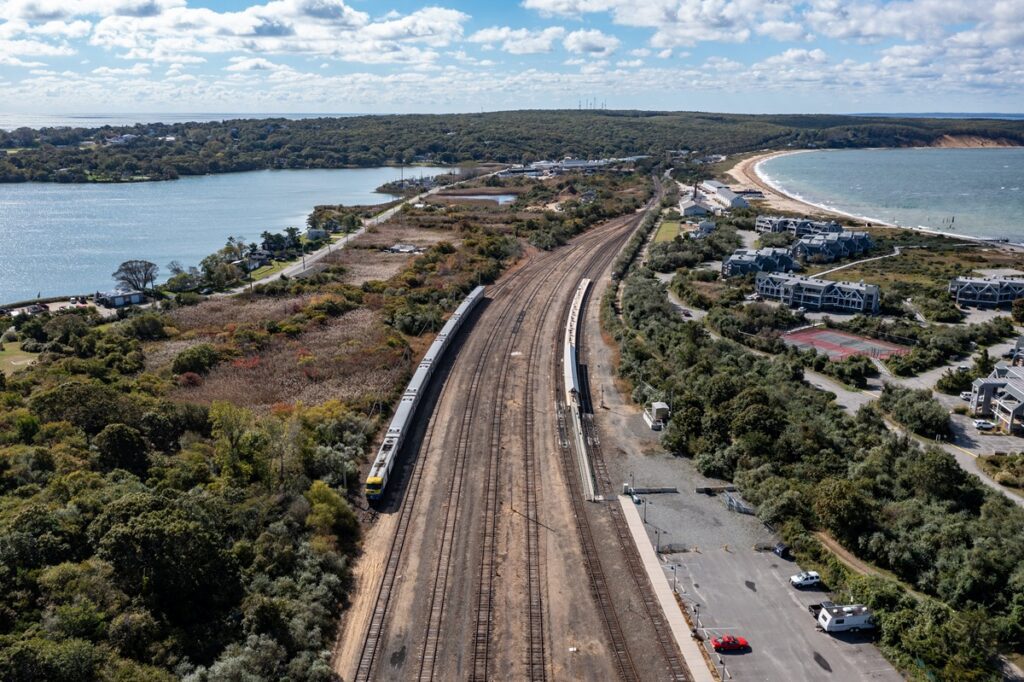
Penn Station is the departure point. The Long Island Rail Road Montauk Branch runs direct from Penn Station and deposits you at Montauk Station—a 1927 depot building now repurposed as an art gallery—in roughly three hours. Off-peak tickets run between $30 and $33 each way; always buy before boarding, since conductors charge a surcharge for on-train purchases. The MTA TrainTime app handles tickets and real-time tracking.
A word for Jersey readers specifically: this is the same Penn Station you already use for NJ Transit. You know the building, you know the platforms. The LIRR is on the lower level. The Montauk Branch train is diesel-powered east of Babylon, which means it sounds different and smells different and feels, honestly, more like an adventure. In summer, The Cannonball runs the full route in about two hours and forty minutes. In the off-season, it takes a bit longer and the train is quieter and the beaches are yours.
Why Montauk Is Worth the Trip
Once in Montauk, the village itself is walkable. The lighthouse and Camp Hero require a ride—taxi, rideshare, or if you’re ambitious, a bike from one of the rental shops in town.
This historic seaside town has quietly appeared in films like Eternal Sunshine of the Spotless Mind and even inspired scenes in Stranger Things—but most visitors come for the beaches and old-school seaside charm.
The End of Everything, Which Is to Say, the Beginning
Montauk occupies the absolute eastern tip of Long Island—past East Hampton, past the hedgerows and the summer-share apartments, past all of it—where the island simply runs out of land and drops into the Atlantic. The name itself comes from the Montaukett people, an Algonquian-speaking nation whose territory covered the eastern end of Long Island for at least three thousand years before a Dutch explorer named Adriaen Block sailed around the point in 1614 and scrawled a Dutch word for it on a map. The name he used didn’t stick. Theirs did.
The Montaukett were a coastal people in the deepest sense: fishermen and farmers, makers of wampum—the disk-shaped shell beads that functioned as currency across the northeastern woodlands and made eastern Long Island the economic mint of pre-colonial America. The Montaukett were so central to the regional economy that the English and Dutch both spent considerable energy trying to control them, first through trade, then through debt, then through a series of land transactions that stripped the tribe of virtually everything they’d held for millennia. A court ruling in 1910 formally declared the Montaukett ‘extinct’—a piece of judicial sleight-of-hand that the tribe has contested ever since, and which the New York State governor vetoed recognizing again as recently as December 2024. The land kept their name. The state still won’t acknowledge the people.
All of which is to say: you are not visiting a simple beach town. You are visiting a place where several thousand years of human history have stacked up like sediment—visible in the place names, the shape of the coastline, the trails through the brush that deer still use because the Montaukett used them first.
The Oldest Ranch in America
Most people know Montauk as a summer destination—the social endpoint of the Hamptons, where the scene eventually runs out of real estate and collapses into the ocean. What almost nobody outside of Long Island knows is that somewhere beneath all of that is the oldest working cattle ranch in the United States.
Deep Hollow Ranch was established in 1658—that is, twenty-two years before William Penn got to Pennsylvania, a century and a half before Lewis and Clark set out for the Pacific. It was originally used as seasonal pasture, a place where cattle and sheep were driven to graze on the maritime grasses each summer before the long walk back west. At its peak, something like 6,000 head of cattle moved through here each year. The ranch was eventually recognized by the National Geographic Society as the oldest in the country. Today it runs about forty horses and offers guided trail rides that wind through dunes, meadows, and ultimately down to the beach at Oyster Pond—where, if you look at the sand closely, you’ll notice it’s tinged purple. Ancient glacier deposits left garnet crystals in the shoreline. The waves sort the heavier minerals into streaks that catch the light. It’s the kind of detail you only find if you slow down long enough to look.
The ranch sits inside Montauk County Park, surrounded by thousands of acres of preserved coastal land. Trail rides go year-round, weather permitting. Reservations are required.
The Lighthouse George Washington Ordered
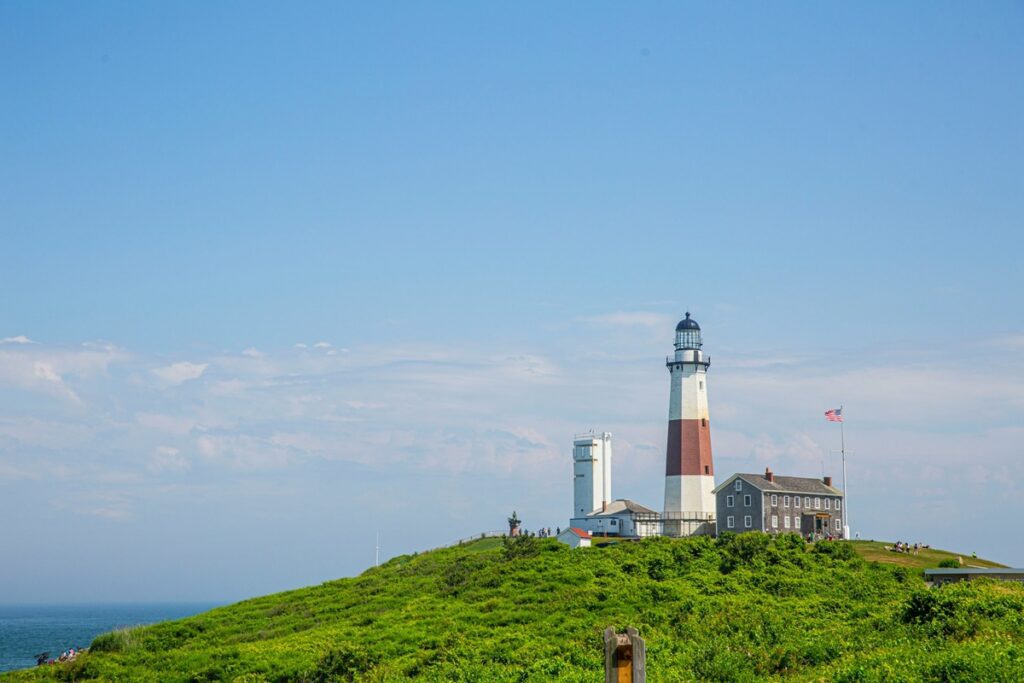
The Montauk Point Lighthouse was commissioned by George Washington himself in 1792 and completed in 1796, making it the first lighthouse in New York State and one of the oldest in the country still actively guiding ships. Standing at the bluffs on a clear day, with the Atlantic breaking below and Block Island visible in the distance on the right kind of afternoon, it’s easy to understand what Washington was trying to protect—the approach to Long Island Sound, the mouth of the harbor that would become the most important port in the young nation.
The lighthouse has a small museum inside and the tower itself is climbable for a fee. But the real reason to go is to stand at the edge of the bluffs and look out at the water. This is the Montauk that existed before Carl Fisher, before the Hamptons scene, before the Summer Fridays crush and the waiting lists at the trendy hotels. This is the Montauk that has been here since before there was a country to build it.
The Base That Wasn’t Supposed to Exist
In January 1942, the Army quietly purchased 468 acres at the eastern tip of Montauk. The official paperwork—signed by the Secretary of War—described it as a ‘battery site and for related military purposes.’ When the local Long Island paper asked for more detail, officials refused to provide any.
What they built was Camp Hero, a coastal defense installation so classified that the Army disguised it as a New England fishing village to avoid detection from the air. Concrete bunkers had windows painted on their facades. A gymnasium was given a fake steeple and sold as a church. The facility eventually housed 600 enlisted men and 37 officers, along with four massive casemate guns—each gun fifteen feet long, capable of firing shells twenty-three miles out into the Atlantic to intercept enemy ships. The test firings reportedly sent bottles flying off shelves at Shagwong Tavern.
The Cold War brought a new chapter. Camp Hero was reopened as the Montauk Air Force Station in 1951 and eventually fitted with one of the largest radar towers on the East Coast—a 70-ton SAGE dish that fed data to military installations including McGuire Air Force Base in New Jersey, serving as an early-warning node in the defense grid aimed at Soviet bombers. The base operated in near-total secrecy until its official closure in 1981. When the deed was finally handed over to New York State in 1984 as parkland, the paperwork contained a notable clause: the state received ownership of everything above the surface.
That detail, probably mundane in its original bureaucratic context, became the seed for one of the stranger chapters in American conspiracy lore. A 1992 book called The Montauk Project claimed the base had been used for time-travel experiments, mind-control programs, and worse. FOIA requests filed over three decades have turned up nothing to support any of it—just radar staffing documents and environmental cleanup reports. But the sealed bunkers are still there. The radar tower still looms over the bluffs. And whatever is or isn’t below the surface, the government has never relinquished the claim. It’s this ambiguity—factual, documented ambiguity—that reportedly inspired the creative team behind a small Netflix show originally conceived under the working title Montauk before it became Stranger Things.
Camp Hero State Park opened to the public in 2002. The trails through the former base are open year-round, free of charge, from sunrise to sunset. The bunkers are still sealed. The radar tower is still there, behind a fence, slowly rusting. It is one of the more genuinely eerie places on the entire East Coast, and it is worth every minute.
Rum Runners, Rough Riders, and the Rolling Stones
The history between the cattle ranch and the Cold War is crowded with characters. After the Spanish-American War, Teddy Roosevelt quarantined his Rough Riders at nearby Shadmoor—the soldiers and their horses recovering from Cuba before they were allowed back among the civilian population. A trail there still carries the name.
Prohibition turned Fort Pond Bay into one of the busiest smuggling corridors on the Atlantic seaboard. Ships would anchor just beyond U.S. territorial waters in a loose formation locals called Rum Row, waiting for small craft to dart out from shore after dark. The beach names from that era—Gin Beach, Oyster Pond—tell you where the cargo was offloaded. Much of it was stashed in the dunes before being rushed to speakeasies in the city. The most glamorous of the local watering holes during that period was the Island Club on Star Island, operated by developer Carl Fisher—the same man who had imagined Montauk as a grand Atlantic City of the north, with a grand hotel and a yacht club and a vision of the place as a transatlantic ocean liner port. Fisher’s dreams outpaced his money, and the Depression ended them. The Island Club was raided in 1930.
Fisher’s fingerprints are still visible on the Montauk Manor, the hilltop hotel he built in 1927 whose Spanish Colonial silhouette still presides over the town from above. And it was Fisher who built the original barns at what would become Deep Hollow Ranch.
By the 1970s, a different kind of American aristocracy had found Montauk. Andy Warhol bought a sprawling clifftop ocean property in 1971 and used it as a summer rental. His first tenant was Lee Radziwill, who that summer brought her sister—Jackie Kennedy Onassis. In 1975, the Rolling Stones rented the Warhol compound for the summer. Mick Jagger was known to eat clams at Shagwong Tavern and wrote about the Memory Motel, a few miles down the road, on the Black and Blue album. Jackson Pollock had worked just down the coast in the Springs for decades. Willem de Kooning. Edward Albee. There is something about the quality of light at the end of Long Island—the way it flattens and diffuses, the way the ocean seems to be present even when you’re not looking at it—that has always drawn a certain kind of restless creative attention.
What to Do, Without a Minute Wasted
The lighthouse and Camp Hero State Park together make a logical morning—roughly adjacent, connected by the same stretch of coastline where Montauk’s deepest history sits. The lighthouse museum opens at 10:30 AM most days; Camp Hero’s trails open at sunrise. Get there early and you’ll have the bluffs to yourself.
Deep Hollow Ranch is east of town off Route 27 and requires advance reservations. The beach trail ride—ninety minutes, age eight and up—ends at Oyster Pond, where the purple garnet sand waits. Call ahead: 631-668-2744.
Ditch Plains Beach is the surfing hub, a rocky crescent about a mile west of town where the breaks are reliable and the crowd is a mix of serious surfers and people who just want to watch. Hither Hills State Park has calmer water, freshwater ponds, and trails through scrub oak. Shadmoor, with its own WWII bunkers and coastal bluffs, is smaller and often overlooked—which is exactly the reason to go.
For food: Gosman’s Dock is the institution, a sprawling seafood complex on the harbor where fishing boats tie up directly. It’s loud and unpretentious and the clams are excellent. Shagwong Tavern has been open in various forms since the rum-running era; it is not fancy, and that is a virtue. The Surf Lodge is the place for the fashion crowd, live music on the deck, and a cocktail at sunset over Fort Pond. Duryea’s and Crow’s Nest are both worth the trip for the view alone.
Where to Stay, If the Day Isn’t Enough
Montauk Manor, the hilltop Carl Fisher hotel from the spring of 1927, is the historic choice—sweeping views of the bay, a faded grandeur that suits the place, a courtesy shuttle down to the beach and town. Gurney’s Montauk Resort & Seawater Spa is the only year-round oceanfront resort in the area, with a seawater pool and direct access to a long private beach. The Surf Lodge doubles as a concert venue—boutique rooms on Fort Pond, live music in the warm months, the kind of hotel that is genuinely more interesting than its website suggests.
For something more grounded: Daunt’s Albatross Motel is a family-run property steps from the beach that has been a Montauk fixture for decades. It is affordable, it is well-run, and it is the anti-Hamptons choice in the best possible sense. Marram is the minimalist alternative—oceanfront, fire pits, surf lessons, the hotel version of a deep breath.
Why Now, Why This
The Hamptons are moving east. Anyone who has watched what happened to Asbury Park, what happened to Montclair, what happened to every New Jersey town that the city discovered and eventually priced past recognition—you understand the pattern. Montauk has held out longer than most. It still has working fishermen and weathered motels and bars that don’t have velvet ropes. It still has a ranch that has been running cattle since before the British burned New York.
The $30 train ticket is not incidental to the story. It is the story. Montauk is not behind a toll booth or a seaplane charter or a seat on someone’s yacht. It is behind a LIRR ticket you can buy on your phone while waiting for the 34th Street escalator. For readers from the Shore—people who understand what a real beach town feels like before it becomes a brand—Montauk is the version that, somehow, still mostly is one.

The New Jersey Digest is a new jersey magazine that has chronicled daily life in the Garden State for over 10 years.