

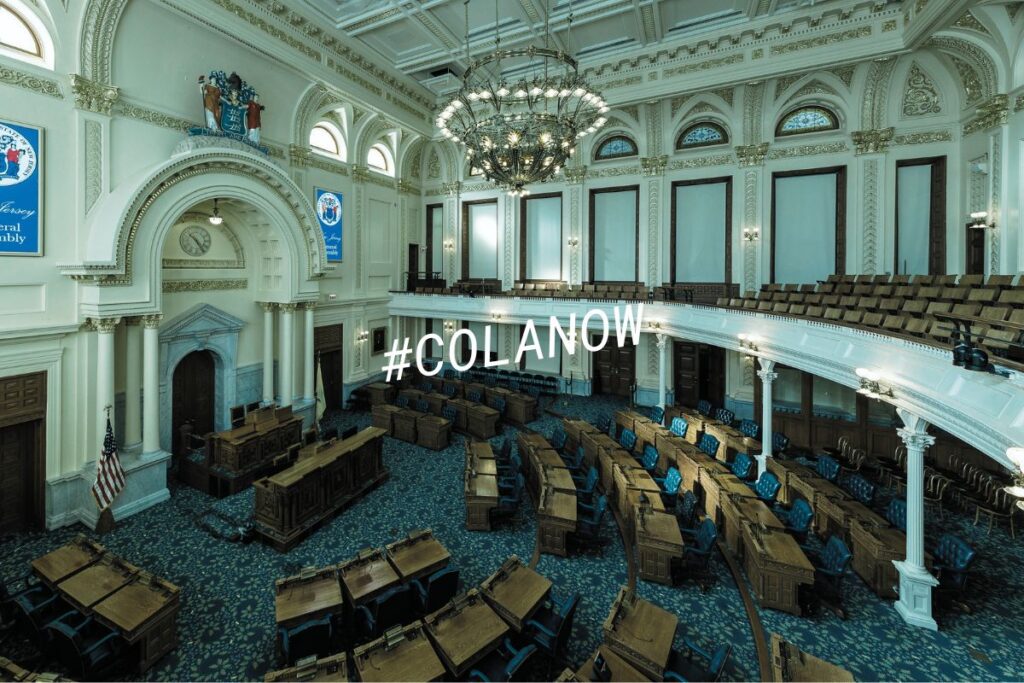

For some politicians, COLA is a line item in a budget. For New Jersey retirees, it’s the difference between staying in the state they spent their careers serving—and being forced to leave.
The hashtag #COLANOW has been flooding the comment sections of New Jersey politicians’ social media posts for months. Behind it are tens of thousands of retired public employees—teachers, state troopers, police officers, firefighters—who haven’t seen a cost-of-living adjustment to their pension since Governor Christie suspended the program in 2011.
15 years. Three governors. Billions of dollars in back pension payments. Still no COLA.
Here’s what it is, why it disappeared, and what’s actually standing in the way of bringing it back.
What Is COLA?
COLA—AKA Cost-of-Living Adjustments—are annual increases applied to pension payments to protect retirees from inflation. The idea is straightforward: if the cost of everything goes up, the pension that a retired public employee relies on should keep pace.
Under New Jersey law, that protection was suspended in 2011 under Governor Chris Christie as part of a sweeping pension and benefits reform bill passed with bipartisan support. The pension system was severely underfunded—the result of decades of governors from both parties skipping or shorting annual payments—and the state needed to stop the bleeding. COLA was among the benefits cut.
Since then, inflation has continued to climb. Over just the past year, the annual inflation rate hit 3.3% (March 2026 figure). A pension that felt sufficient at retirement in 2012 is worth meaningfully less in real terms today. For retirees on fixed incomes in one of the most expensive states in the country, that gap compounds every year.
Kevin, a retired New Jersey State Trooper whose story was shared by the Assembly Republican caucus, put it plainly. He planned his retirement around the system he paid into his entire career. Now he’s working in retirement just to keep up with rising costs—and considering leaving the state altogether.
“I love New Jersey. Born here, raised here, worked here, raised my family here. But I may have no other choice.”
The Push to Restore It
The #COLANOW movement has found an unlikely home in the New Jersey Assembly Republican caucus. Assemblyman Alex Sauickie authored legislation—Bill A1168—to restore cost-of-living adjustments specifically for Police and Firemen’s Retirement System (PFRS) retirees and State Police retirees who have been retired for at least 10 years. Notably, he doesn’t extend the effort to retired teachers, who also lost benefits after the program shuttered.
“Our retired police officers and firefighters spent their careers protecting our families, our neighborhoods, and our communities,” Sauickie wrote. “They should not be left behind while the cost of everything continues to climb.”
The New Jersey State Retired Police and Firemen’s Association has been even more direct. In a statement posted to Facebook, the organization noted that the COLA suspension was imposed by a Republican governor—and that every Democratic governor and legislature that followed chose not to restore it either.
“A Republican Governor lied to us and suspended our COLA. Since then the state has been led by a Democratic Governor, Democratic Senate and a Democratic Legislature. They could have restored COLA any time during that period of time. They chose not to.”
It’s worth pausing on that political dynamic. The loudest current push for COLA restoration is coming from New Jersey Republicans—the same party whose governor suspended it in the first place. Whether that represents a genuine change of heart, a political opportunity, or both is a question worth sitting with.
What’s harder to dispute is that neither party has delivered on it. The association suggested that legislators who have grown tired of hearing the phrase “COLA Now” recently found time to debate naming the hazelnut the official state nut. Maybe a stretch—but frustrating for COLA advocates nonetheless.
What’s Holding It Back
The short answer is the math.
New Jersey’s pension system is currently funded at approximately 53.8% of its total liabilities, based on July 2024 actuarial data. State law—the same 2011 reform bill that suspended COLA—requires the pension system to reach an 80% funded ratio before COLA reinstatement can even be considered. The Office of Legislative Services projects that milestone won’t arrive until evaluation year 2042, meaning retirees are realistically looking at FY2044 at the earliest before the door legally opens.
Governor Sherrill’s administration has made full pension funding a priority. The recently passed FY2027 budget earmarks more than $7 billion for the state’s annual pension obligation—the sixth consecutive year of full actuarial contributions and a figure that represents roughly one-tenth of the state’s total $60.7 billion spending plan.
On COLA specifically, the Sherrill administration’s position is clear: not yet.
“We know, without a COLA, for some pensioners, it creates a challenge,” State Treasurer Aaron Binder told lawmakers during budget hearings, according to NJ Spotlight News. “However, the top priority for us, right now, is to get the pension system well-funded.”
Even when the 80% threshold is reached, restoration isn’t automatic. The law gives pension committees discretionary authority to consider reinstating COLA—but nothing compels them to act. And reinstating COLA would add significant new liabilities to a system that is still decades from full funding.
There is one notable exception. Under a 2018 law, the PFRS—the fund covering police and fire retirees—has its own independent Board of Trustees with the authority to consider adjustments outside the standard 80% threshold.
That’s the opening Sauickie’s A1168 bill is attempting to walk through. As of June 2026, it remains in committee.
What Retirees Are Left With
The legal picture was settled in 2016, when the New Jersey Supreme Court ruled in Berg v. Christie that public employees have no contractual right to future COLA adjustments. The state legislature has the authority to suspend benefits during fiscal crises—and it exercised that authority.
That ruling didn’t make the situation any more palatable for retirees who planned their lives around a promise that was later taken away. The retired police and fire association said it plainly: “This is something that was earned and promised to us.”
The numbers back them up. 15 years of inflation represents a real and ongoing reduction in purchasing power for every affected retiree. The state’s pension system is in better shape than it was a decade ago, but there’s still a ways to go. And for retirees counting the years, the gap between where the funded ratio is today and where it needs to be before COLA can even be discussed is measured not in months but in decades.
The push isn’t going away—retirees have made that clear. Whether the political will to match their urgency ever materializes is a different question.

The New Jersey Digest is a new jersey magazine that has chronicled daily life in the Garden State for over 10 years.