

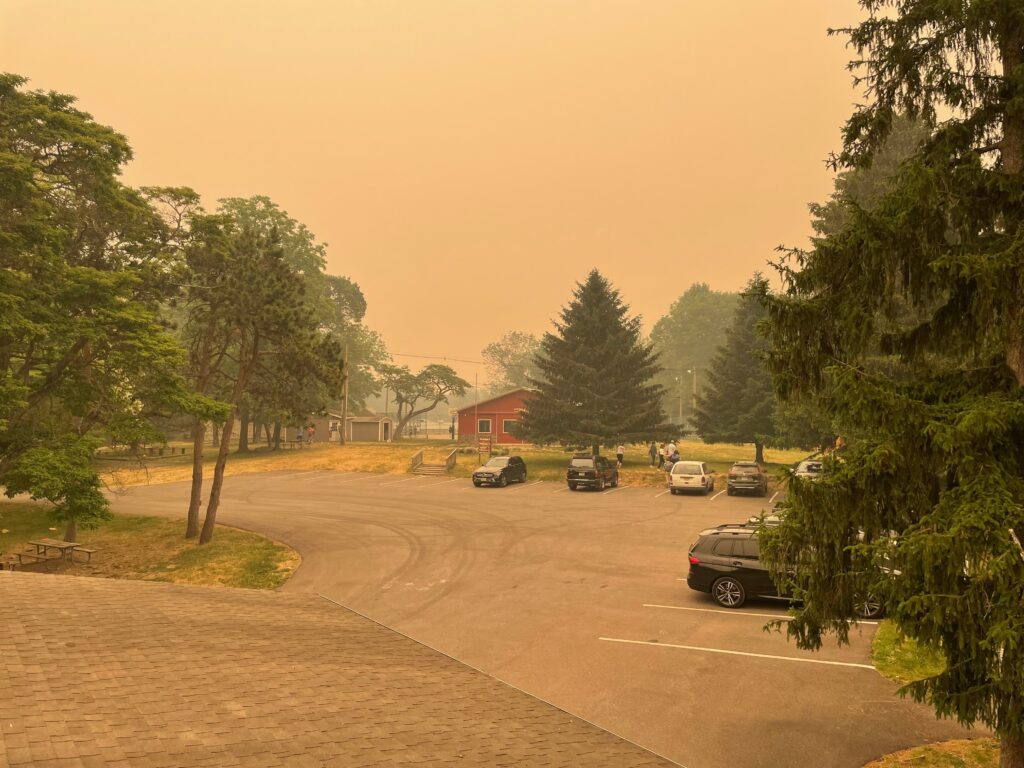

New Jersey is bracing for a hazy, smoky, and dangerously hot Wednesday. It’s a rare combination of extreme heat, severe storm risk, and Canadian wildfire smoke all hitting the state at once.
Smoke from more than 3,000 wildfires burning across Canada, which have scorched nearly 4.5 million acres this summer—is drifting into the Northeast, according to ABC. The CBC reported 128 confirmed wildfires burning throughout Ontario as of Tuesday, with some tearing through thick forest and generating even heavier smoke. Skies in parts of New Jersey were already hazy Tuesday, with many residents reporting a smoky aroma in the air.
The National Weather Service expects near-surface smoke to spread into the region starting Wednesday evening—intensifying into Thursday. “This is the kind that you’ll be able to smell outside, reducing visibility and potentially causing air quality issues,” the agency said, according to NJ.com. Forecasters don’t expect effects to be as severe as the historic wildfire aftermath of June 2023, though orange-hued, haze-filled skies are still likely.
Smoke arrives in the Garden State on top of a dangerous heat wave. Wednesday’s highs are expected to near 100 degrees, with heat indices between 100 and 109 degrees for most of the state. Extreme Heat Warnings are in effect from 10 a.m. to 8 p.m. for Burlington, Camden, Gloucester, Mercer, Middlesex, Monmouth, Ocean, and Somerset counties, with the rest of New Jersey under a heat advisory.
Wednesday could break decades-old heat records: 100 degrees expected at Atlantic City airport, 101 at Trenton, and 104 at Newark.
Rounding out the threat, a cold front will move through the state late Wednesday afternoon into the evening, bringing a slight risk (level 1 of 5) of severe thunderstorms. Dangerous winds and even hail are possible across most of the state.
Wildfire smoke of this scale isn’t just a New Jersey problem—it’s affecting more than 100 million people across the Midwest and Northeast. The smoke contains fine particulate matter known as PM2.5, tiny enough to penetrate deep into the lungs or enter the bloodstream. Children, older adults, and people with heart or lung conditions face the highest risk of smoke-related illness.
Health officials recommend checking your local air quality index before heading outdoors. If conditions reach “code red, purple, or maroon” on the air quality scale, everyone should limit time outside.
For now, smoke from Canadian wildfires is making its way into New Jersey. Combined with potentially record-breaking heat, it spells a recipe for dangerous conditions. Stay inside when possible—Wednesday is shaping up to be extreme. Literally.

The New Jersey Digest is a new jersey magazine that has chronicled daily life in the Garden State for over 10 years.